
The Five-Year Yuga of the Vedas
India's oldest astronomy text measured time in five-year cycles starting at the winter solstice. Why five? The answer lies in the Vedic love of the five-fold.

Long before horoscopes, long before the zodiac signs were drawn into Indian charts, there was a simpler and more urgent problem. When exactly should the sacrifice be performed?
The Vedic ritual, yajna, had to happen at the right moment: the right day of the Moon's cycle, the right season, the right turning of the Sun. Getting it wrong spoiled the rite. Out of that need grew Jyotisha, one of the six Vedangas, the "limbs" of the Veda. It's often called the eye of the Veda, because it tells you when.
Its oldest surviving text is the Vedanga Jyotisha.
A pocket guide to time
The Vedanga Jyotisha survives in a few versions. The Rigveda recension and the Yajurveda recension are ascribed to the sage Lagadha, and were composed and preserved by his disciple Shuchi. A third belongs to the Atharvaveda.
B.N. Narahari Achar, in his note The Five-Year Yuga of the Vedanga Jyotisha, describes the Rigveda version as "a pocket reference" written in compact verse, "easy for memorization but sometimes difficult for understanding." Its stated subject is the science of time itself: how to measure it and how to find the proper moment for each rite.
The five-year yuga
Its most distinctive feature is its basic cycle: not a year, but a yuga of five years. (This is a different "yuga" from the vast cosmic ages of later texts.)
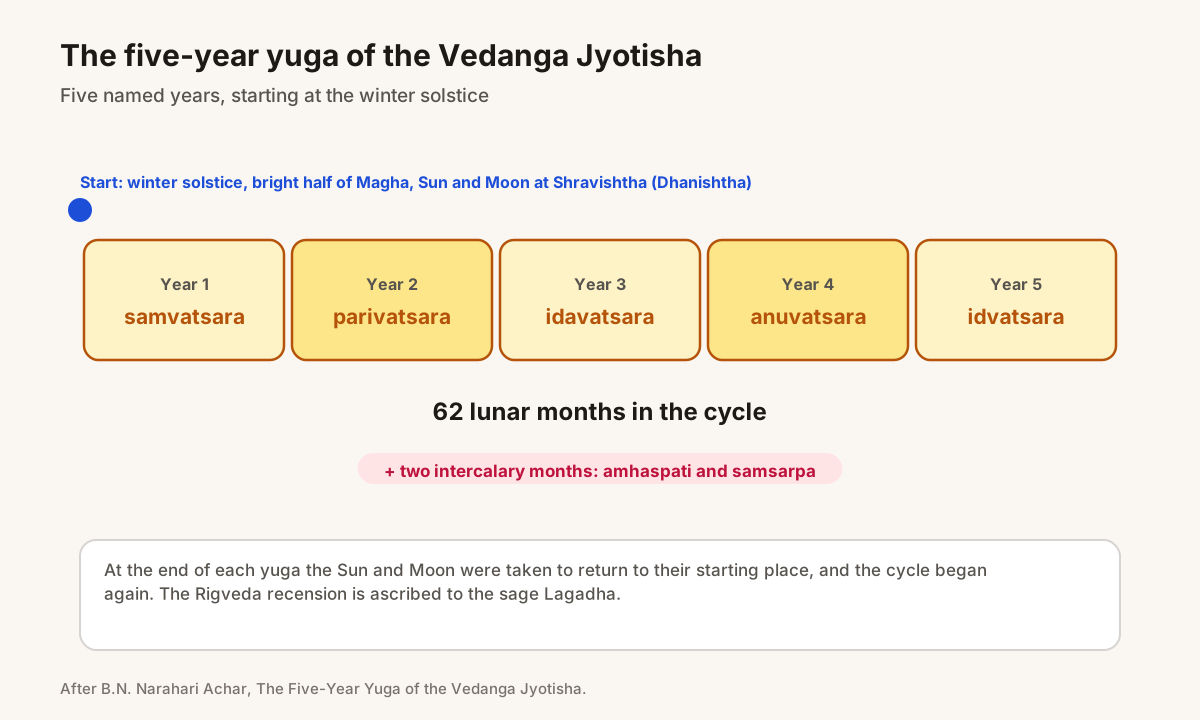
- The yuga began at the winter solstice, at the start of the bright half of the lunar month of Magha, with the Sun and Moon together near the stars of Shravishtha (Dhanishtha).
- It held 62 lunar months and two intercalary months that kept the lunar calendar in step with the seasons.
- At the end of each yuga, the Sun and Moon were taken to return to the same starting place, and the cycle began again.
Its five years even had names: samvatsara, parivatsara, idavatsara, anuvatsara and idvatsara. The first two already appear in the Rigveda. The two extra months had names too, amhaspati and samsarpa, recorded in the Taittiriya Samhita. As Achar points out, the five-year cycle and the intercalary months are older than the Vedanga Jyotisha itself. Lagadha inherited them.
"Crude"? Or meaningful?
Modern historians have sometimes been harsh about this cycle. Five solar years and 62 lunar months don't match perfectly. Over a few cycles, the solstice drifts and the tithis slip. One critic even concluded that the Indians "were not interested in performing the simplest acts of observational astronomy."
Achar argues the opposite, from the texts themselves. The Vedic priests had to watch the sky closely. It was their duty to observe the last sight of the old Moon and the first sight of the new one, because the ritual calendar depended on it. The Vedanga Jyotisha even defines the special day (upavasatha) by the moment the Moon rises almost with the Sun. People doing that every month would have noticed any drift and corrected it.
So why keep a five-year cycle at all? His answer is the most beautiful part of the story.
Everything is five-fold
In Vedic thought, the number five is woven into everything. The Taittiriya Upanishad lists sets of five: the five senses, the five parts of the body, the five koshas or sheaths of the self. Then it declares:
"All this is verily pankta (five-fold); by the pankta, indeed, does one secure the pankta."
The ritual followed suit. The great fire altar of the Agnicayana was built in five layers of bricks, and those layers carried the same names as the five years of the yuga. The Vedanga Jyotisha itself opens by saluting Prajapati, "the embodiment of the five-year period," whose limbs are the day, the seasons, the Sun's northern and southern courses, and the month.
Time, the altar and the cosmic person were all one structure, built in fives. In Achar's words, the five-year yuga lasted "over thousands of years" because it was part of "the same Vedic lore of five-fold manifestations." Its popularity faded only when the great Vedic sacrifices themselves declined.
The cycle that never quite left
The idea didn't vanish. Centuries later, when Varahamihira described Jupiter's great sixty-year cycle in the Brihat Samhita, he still grouped the sixty years into twelve yugas of five years, each presided over by a deity. The third yuga, for example, belongs to Indra. And in Varahamihira's list of what an astrologer must master, "the cycle of sixty years" and "a yuga (a five-year period)" appear side by side.
Why it matters for astrology today
The Vedanga Jyotisha reminds us where Jyotish comes from. It didn't start as fortune-telling. It started as sacred timekeeping: aligning human action with the Sun, the Moon and the seasons, so that each act happens at its proper moment.
Every tool in a modern Vedic chart descends from that impulse: the tithi, the nakshatra, the muhurta, the dasha. When you choose an auspicious time for a wedding, you're doing what Lagadha's students did. You're making sure the action meets the right moment.
The takeaway
India's oldest astronomy text measured time in five-year yugas. They began at the winter solstice with the Sun and Moon together, and two extra months kept the calendar true. The number five wasn't an accident. To the Vedic mind everything was pankta, five-fold, and time was built in fives just like the altar and the self. That's the root from which the whole tree of Jyotish grew.
For the later, much larger yugas, read when did Kali Yuga begin? To see the tithi and nakshatra of your own birth, calculate your chart free.
Discover Your True Planetary Placements
Calculate your true Sidereal Lagna, Chandra Rashi, Nakshatras, and 120-year Vimshottari Dasha timeline with verified astronomical precision.
Calculate Your Free Kundli