
Uttarayana: When the Sun Turns North
Uttarayana, the Sun's northward half-year, is the day of the gods. Why Makar Sankranti no longer falls on the solstice, and what the Sun's two journeys mean.
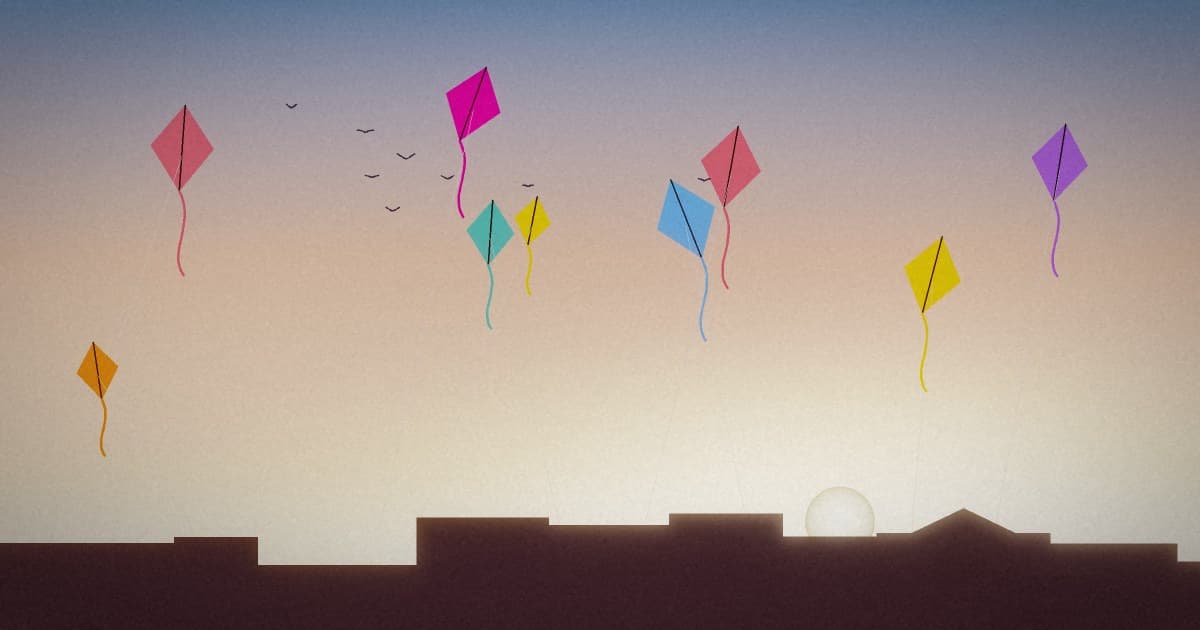
Watch where the Sun rises over a year and you'll see it travel. In December it comes up far to the south-east. Day by day it creeps north along the horizon, and by June it rises far to the north-east. Then it turns around and heads back.
Indian tradition named those two journeys. The Sun's northward half-year is Uttarayana, and its southward half-year is Dakshinayana. Few ideas in the Hindu calendar carry more meaning.
The two journeys
K.S. Charak's Elements of Vedic Astrology quotes a Puranic account of the Sun's course with detailed commentary. The turning points are clear:
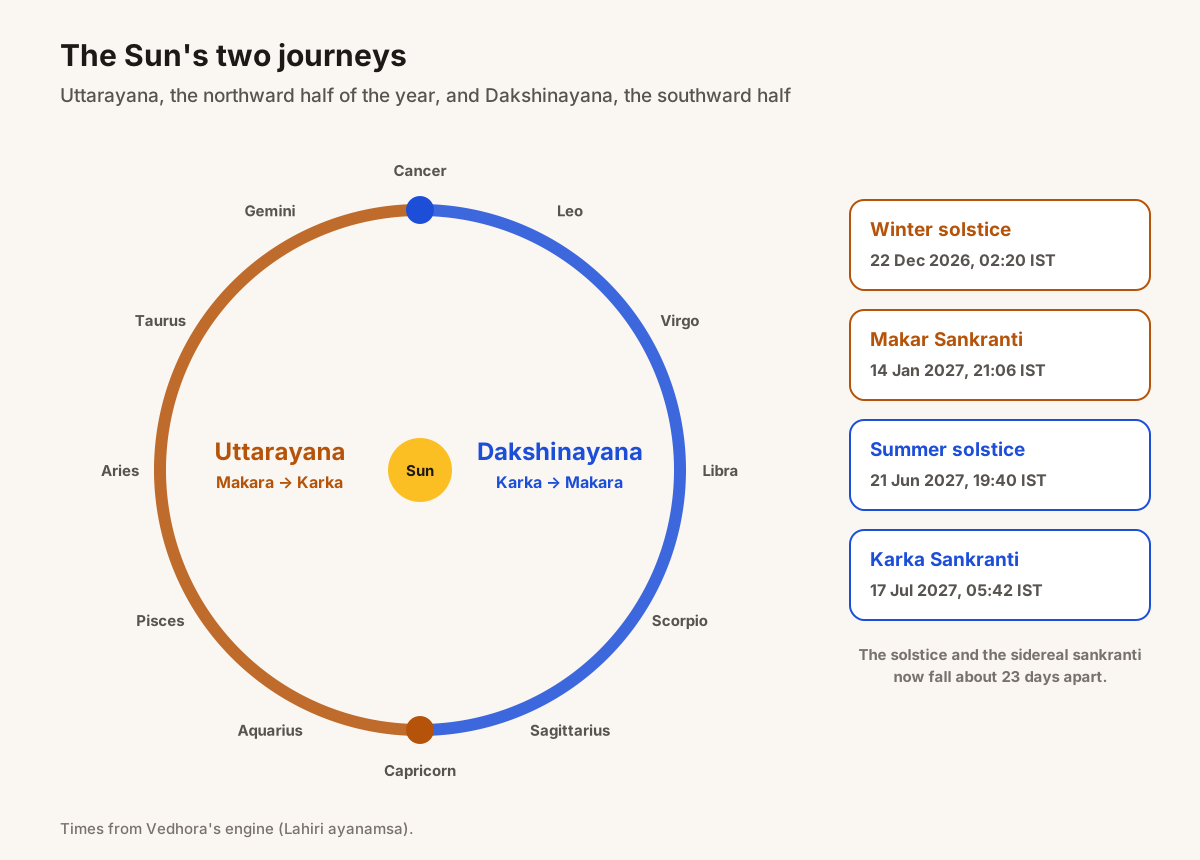
"Sun's entry into Karka is called Dakshinayana and His entry into Makara indicates Uttarayana."
So Uttarayana begins when the Sun reaches Makara (Capricorn). It's the depth of winter, when "the northern hemisphere has the shortest day and the longest night." Day by day the light then grows, through Kumbha, Meena, Mesha, Vrishabha and Mithuna, until midsummer. Dakshinayana begins at Karka (Cancer), the longest day, and the light then slowly shrinks again.
The old texts even measure the day in muhurtas of 48 minutes. At the turning points the day stretches from twelve muhurtas in deep winter to eighteen at midsummer, the night doing the opposite.
The day of the gods
Tradition gives the two halves very different characters. A human year is said to be a single day and night for the gods. Uttarayana is their day, and Dakshinayana is their night. That's why the northward half is considered the auspicious time for new beginnings, consecrations and important rites.
The best-known story about it comes from the Mahabharata. Bhishma, lying wounded on a bed of arrows, chose to wait for the Sun's turn north before leaving his body. In his notes to the Brihat Samhita, M.R. Bhat records that astronomers have used the details of Bhishma's departure, at the start of the winter solstice in the bright half of Magha, to date the great war itself.
Makar Sankranti: the festival of the turn
The festival that celebrates the Sun's entry into Makara is Makar Sankranti, one of the very few Hindu festivals fixed to the Sun rather than the Moon. That's why it falls on almost the same date every year.
Arun Kumar Bansal's Encyclopedia of Astrological Remedies describes the traditional observance as a fast of the Sun, believed to remove troubles and free one from the cycle of rebirth. "Gods come to earth on this day," it says. You bathe in the Ganga if you can, offer water (arghya) to the Sun, and give khichri to Brahmins and to the poor. In many regions the sky fills with kites, and sesame and jaggery sweets are shared.
The 24-day puzzle
Here's something many people have noticed but few can explain. The winter solstice, the Sun's actual turn north, happens around 21–22 December. But Makar Sankranti is celebrated around 14 January. Why the three-week gap?
We ran both through Vedhora's engine:
- Winter solstice 2026: 22 December, 02:20 IST. The Sun reaches its southernmost point and the days start to lengthen.
- Makar Sankranti 2027: 14 January, 21:06 IST. The Sun enters sidereal Makara (Lahiri).
- Summer solstice 2027: 21 June, 19:40 IST.
- Karka Sankranti 2027: 17 July, 05:42 IST.
The gap is about 24 days, and it's no coincidence. It matches the ayanamsa, the roughly 24° gap between the season-based (tropical) zodiac and the star-based (sidereal) zodiac that Vedic astrology uses. Centuries ago the solstice and Makar Sankranti fell together. Because the equinoxes slowly precess, the solstice has drifted earlier against the stars by about a day every 72 years (how ayanamsa works).
So there are really two "turnings". One is the turn of the seasons, at the solstice. The other is the Sun's entry into the stars of Makara, at the Sankranti. Charak's commentary uses the solstice date for Uttarayana. The festival keeps the sidereal date.
Uttarayana in your chart
The two journeys also matter in chart reading. Among the six sources of planetary strength (shadbala) is ayana bala, strength from the Sun's course:
- The Brihat Parashara Hora Shastra says benefics are strong in Uttarayana and malefics in Dakshinayana.
- The Jyotisha Siddhanta Sara specifies that the Sun, Mars, Jupiter and Venus gain ayana bala in northern declination, the Moon and Saturn in southern declination, and Mercury in both.
- In a planetary war, it adds, the planet in the northern course tends to win (how planetary war works).
- For the Sun itself, the Jyotisha Siddhanta Sara notes that its cheshta bala (motional strength) is simply its ayana bala. It is strong during Uttarayana.
So the season of your birth quietly adds to or subtracts from the strength of your planets, and the Sun's strength most of all.
The takeaway
Uttarayana is the Sun's northward half-year, the day of the gods, the season of light growing. It begins at the winter solstice in the sky of the seasons, and at Makar Sankranti in the sky of the stars. The 24-day gap between them is the ayanamsa made visible. Bhishma waited for it, festivals celebrate it, and shadbala builds it into the strength of every planet.
To see whether you were born in Uttarayana or Dakshinayana, calculate your chart free. For the star that marks the end of the monsoon in Dakshinayana, read about Agastya.
Discover Your True Planetary Placements
Calculate your true Sidereal Lagna, Chandra Rashi, Nakshatras, and 120-year Vimshottari Dasha timeline with verified astronomical precision.
Calculate Your Free Kundli