
Halos, Rainbows and Mock Suns
A ring around the Moon, a double rainbow, a 'second Sun': how Varahamihira's Brihat Samhita read the sky's light shows, and what each was said to foretell.
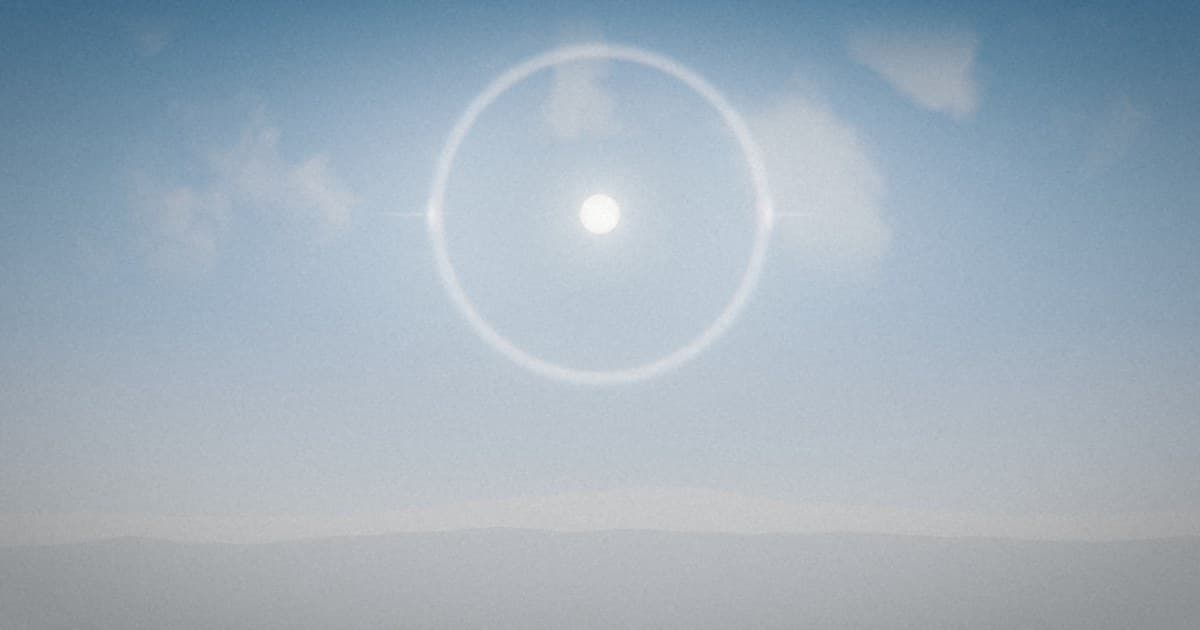
Some days the sky puts on a show. A pale ring circles the Moon. A rainbow arcs over the fields, sometimes two. On a cold, hazy morning, two bright spots appear on either side of the Sun, like smaller Suns standing guard.
Today we call these optical effects: ice crystals, raindrops, refraction. Varahamihira knew they were made of light and cloud too, and that's exactly why he took them seriously. In the Brihat Samhita each one gets its own chapter, and each is read as a message about the days ahead.
The halo (parivesha)
Varahamihira's description is short and physical:
"The rays of the Sun and the Moon turned into a circle by the wind, and reflected in the sky with sparse clouds, become halos possessed of different colours and shapes."
Then he teaches how to read them.
Colour by season. Each season has a natural halo colour. In order from the late-winter season they are like a blue jay, a peacock, silver, oil, milk and water. A halo that is glossy, clear, unbroken and true to its season "conduces to peace and prosperity."
Rain coming. A thick, glossy halo in the season's colour, with little razor-like clouds around it, means rain the same day. Anyone who has watched a ring around the Moon thicken before a storm will nod at this one.
Warning signs. A halo that lingers from morning till evening, or looks blood-red, rough, broken, or shaped like a cart, a bow or a triangle, is a bad sign. One coloured like a peacock's neck means very heavy rain. Two rings mean danger to the army's commander. More than two mean fighting and a town under siege.
A planet inside the ring
Here the Samhita does something clever. It ties the sky event to the planets:
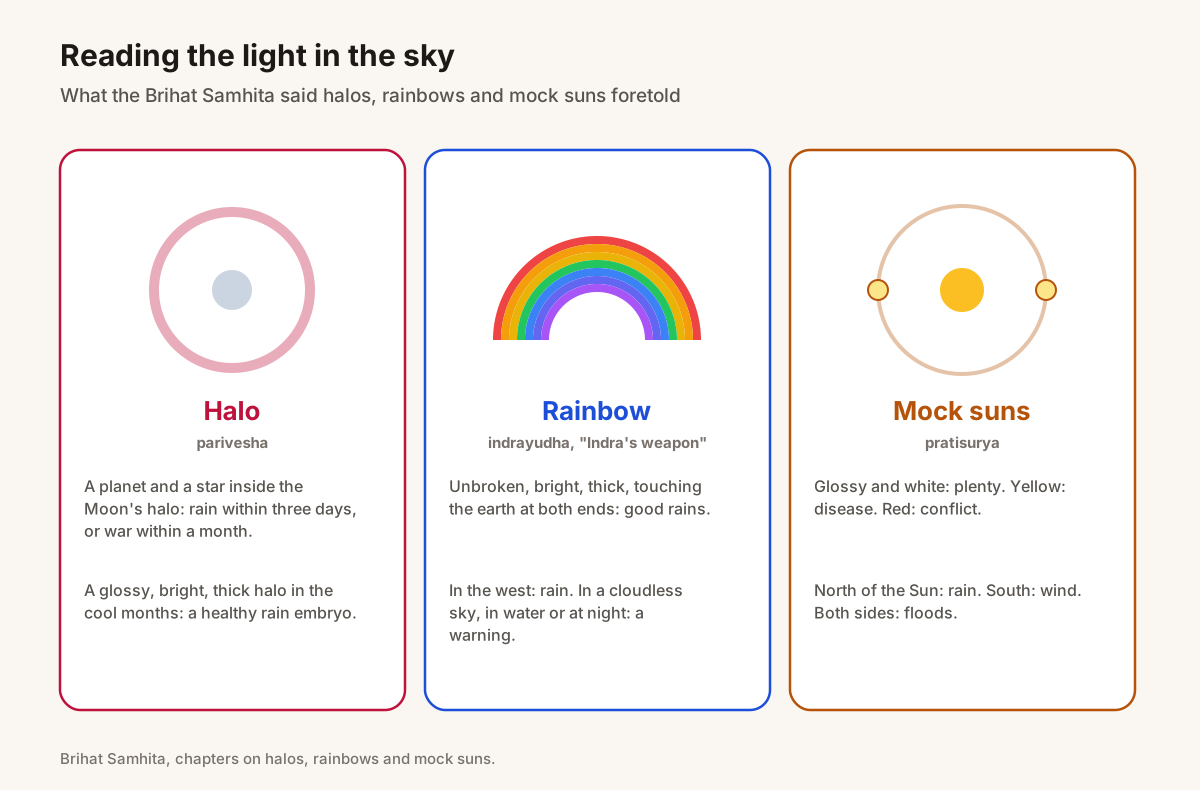
"When a planet and a star are encircled by the halo round the Moon, there will be rain within three days, or a war will break out in a month."
Which planet sits inside the ring changes the meaning. Mercury inside the Moon's halo brings prosperity to ministers and writers, and good rains. Saturn brings stormy rain and harm to crops and farmers. Mars brings trouble from fire and weapons.
Then comes the most personal rule of all. The halo is said to be dangerous for a king if it encloses his own ascendant lord, his natal Moon sign or his birth star. This is the Samhita and the Hora branches meeting in a single moment: a sky event read against an individual's birth chart.
The rainbow (indrayudha)
The Sanskrit name for the rainbow is Indra's weapon: the bow of the god of rain. Varahamihira gives two explanations side by side. The first is his own:
"The multi-coloured rays of the Sun, being dispersed by the wind in a cloudy sky, are seen in the form of a bow which is called the Rainbow."
The second he attributes to older sages like Kashyapa: that the rainbow is the breath of the serpents descended from Ananta. He records the old belief faithfully, and he leads with the explanation from light.
A good rainbow is "unbroken, bright, glossy, thick, multi-coloured and touching the earth at both extremities". A double rainbow is auspicious too, and all of these "yield good rains."
Direction matters. A rainbow in the west always signals rain. One in the east when it isn't raining means rain is coming. A rainbow in a cloudless sky, one standing in water, or one seen at night was taken as a warning.
The city in the air (gandharva nagara)
Some of the most haunting lines describe the gandharva nagara, a "city of the celestial musicians" that appears in the sky, complete with "streamers, banners and gateways." In hot, still air over plains and deserts, mirages can do exactly this, lifting distant buildings and trees into shimmering towers above the horizon.
Varahamihira read these too by direction and colour. A sky-city in the north was said to bring victory to kings defending their towns. One in the colours of smoke, fire and rainbow was said to bring trouble.
Mock suns (pratisurya)
Finally, the mock sun: a bright patch beside the real Sun, often with a hint of colour. Today it's called a sun dog. The commentary explains it plainly as "nothing but a reflection of the Sun's disc in the thin clouds near the Sun in the morning hours."
The reading follows familiar lines:
- Glossy, white, beryl-like and in the season's colour: happiness and plenty
- Yellow: disease. Red like Ashoka flowers: conflict.
- North of the Sun: rain. South: strong wind. On both sides: danger from floods.
- A row of mock suns: a cluster of troubles
Why read the sky this way?
Because for the Samhita astrologer, the sky was a single living text. Halos, rainbows and mock suns form in the same air that brings the rain and the wind. So they were natural messengers of weather, and through weather, of harvests and the life of a whole land. The planets, stars and Moon shone through that same air, so a planet caught in the Moon's ring could carry its own meaning.
There's a gentler lesson too. These chapters train you to look up and notice: the colour of a ring, the side of a sun dog, the shape of a bow. Every reading in the Samhita starts with that kind of attention.
The takeaway
The Brihat Samhita treats the sky's light shows as language. It describes halos, rainbows and mock suns in physical terms, then reads them for weather, for public affairs and, for anyone whose birth star the halo encircled, for personal fortune. It's a reminder that Jyotish began with careful, patient looking.
For the forecasting system these signs fed into, read can the stars forecast the monsoon? To see your own birth star, calculate your chart free.
Discover Your True Planetary Placements
Calculate your true Sidereal Lagna, Chandra Rashi, Nakshatras, and 120-year Vimshottari Dasha timeline with verified astronomical precision.
Calculate Your Free Kundli