
Can the Stars Forecast the Monsoon?
Varahamihira held that rain clouds 'conceive' in winter and 'deliver' 195 days later. Cloud pregnancy, the Rohini yoga, an early rain gauge and signs of rain.
In an agricultural land, one question mattered more than any other: will the rains come? Varahamihira knew it. He opens his chapters on rain with a line any farmer would agree with:
"As food forms the very life of living beings, and as food is dependent on the monsoon, it should be investigated carefully."
What follows in his Brihat Samhita is one of the most ambitious forecasting systems of the ancient world. It's built on a single, beautiful idea: clouds get pregnant.
The 195-day pregnancy
The idea is called garbha, the pregnancy (or "embryo") of the clouds. In the cool months from late autumn to spring, the sky forms embryos of rain. Months later, those same embryos are born as monsoon showers.
The timing is exact. The season of conception starts when the Moon passes the nakshatra Purvashadha in the bright half of Margashirsha (around November–December). Then comes the key rule:
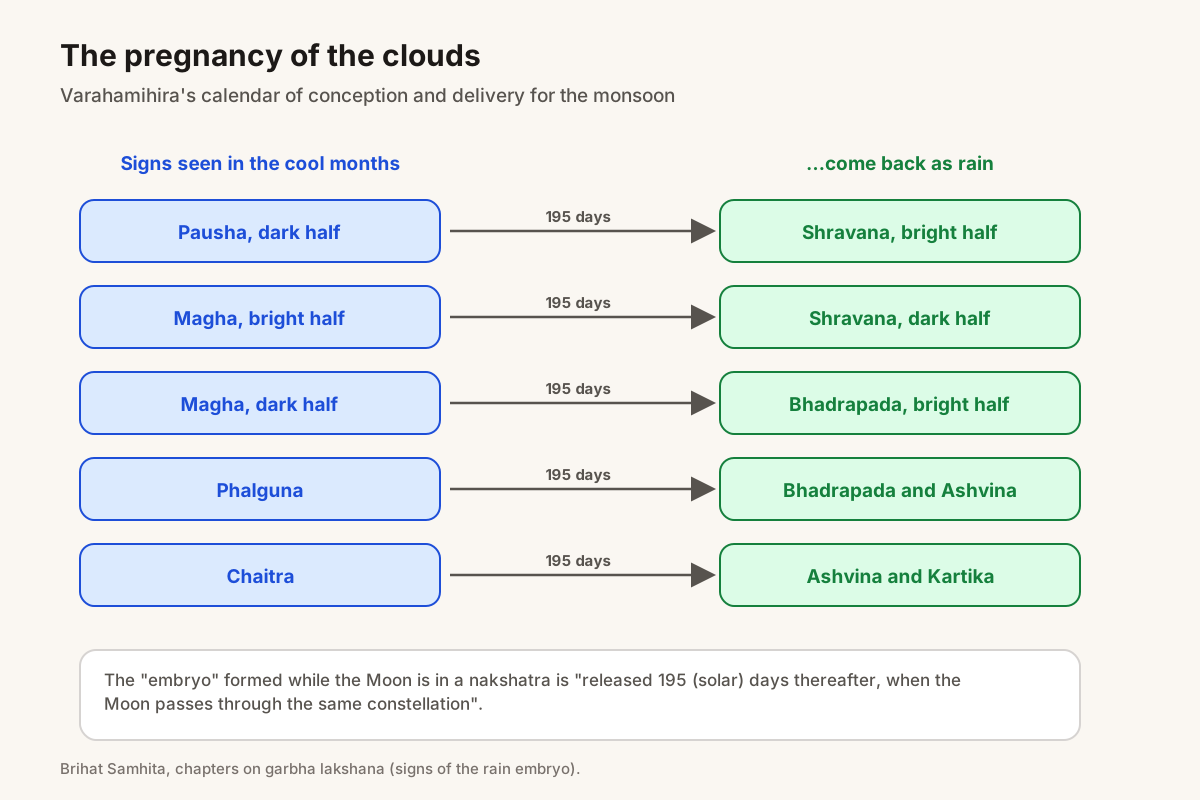
"The foetus formed during the Moon's stay in a particular constellation will be released 195 (solar) days thereafter, when the Moon passes through the same constellation."
So a sky event in winter "books" a rain date in the monsoon, about six and a half months ahead. Varahamihira even gives a calendar of conception and delivery:
- Embryos formed in the dark half of Pausha deliver in the bright half of Shravana.
- Those of the bright half of Magha deliver in the dark half of Shravana.
- Those of the dark half of Magha deliver in the bright half of Bhadrapada.
- Those of Phalguna deliver in Bhadrapada and Ashvina, and those of Chaitra in Ashvina and Kartika.
There's a lovely symmetry to it. An embryo formed in the bright fortnight is born in the dark one, and the reverse is also true. One formed by day rains at night. Clouds that gather in the east pour down in the west, and the wind reverses too.
What a healthy embryo looks like
How do you know whether the winter sky is "conceiving" well? Varahamihira lists the good signs:
- A cool, pleasant breeze from the north, north-east or east
- A clear sky, with the Sun and Moon ringed by a glossy, bright, thick halo
- Large, smooth clouds, some red, some bluish like crows' eggs or a peacock's neck
- Twilights with rainbows, thunder, lightning and mock suns
- Planets that look large and bright, moving north of their stars
- Trees with healthy sprouts, and people and animals at ease
Each month adds its own signs. Margashirsha and Pausha want a red glow at dawn and dusk and frost that isn't too thick. Magha wants strong wind, bitter cold and a misty Sun and Moon. Phalguna wants rough storms, glossy drifting cloud banks and a russet Sun.
Bad signs spoil the embryo, and the rain due on its date comes weak or not at all. An observer who watches carefully, he promises, will make predictions that "will never be falsified, like that of a sage."
The one night that decided the harvest
The most famous test of the season was the Rohini yoga. This isn't the Moon's ordinary monthly pass by the star Rohini (Aldebaran). It's the one meeting that happens in the dark fortnight of Ashadha, just as the monsoon begins.
Varahamihira says the teaching goes back to Brihaspati himself, who taught it to Narada in a celestial garden on the summit of Meru. Astronomers were told to watch that night closely: which way the wind blew, which clouds appeared, how the Moon looked. Everything seen in that one window was read as a forecast for the whole year's crops.
An ancient rain gauge
Then comes a detail that surprises almost everyone. The Brihat Samhita tells you to measure the rain:
"The quantity of rainfall should be determined with the help of a gauge whose diameter is one cubit. When this vessel contains 50 Palas, it will measure one Adhaka."
The reading that counted was the season's first real rain under the rain-bearing nakshatras that begin with Purvashadha. That opening rain was taken as the key to the months that followed. The sages even argued over how widespread it had to be before you could forecast a good season. Kashyapa said any area would do. Devala said ten yojanas. Garga, Vasishtha and Parashara insisted on at least twelve.
Signs that rain is close
For short-range forecasts, the book reads like a field naturalist's notebook. Rain is near when:
- Salt turns moist and water tastes flat
- Frogs croak again and again, and fish leap at the shore
- Ants move their eggs, snakes come down from the trees, and cats scratch hard at the ground
- Iron and bronze vessels gather rust that smells of raw fish
- Mountains look dark as collyrium, with mist in their hollows
- A deep red halo circles the Moon
- Chameleons on treetops gaze at the sky, and cows look up at the Sun
There's even a horary rule. If someone asks about rain while the Moon is in a watery sign in the ascendant or an angle, aspected by benefics, copious rain is near. If the person asking happens to touch water at that moment, or the word "water" is heard, rain is close "without any doubt."
What this tells us about Jyotish
It's easy to picture astrology as only horoscopes. This is the Samhita branch at work: watching the shared sky for the shared fate of a land. It combines lunar timing (the nakshatras), long-range cycles (the 195 days), careful observation (halos, winds, clouds) and measurement (the rain gauge). Varahamihira even asks: is there any science superior to this, "by knowing which alone one gets the power of visualizing the past, present and the future"?
The takeaway
Varahamihira's monsoon forecasting rests on patience. You watch the winter sky night after night, note each sign against the Moon's nakshatra, and count 195 days forward. The method treats the year as one living cycle, where what the sky conceives in the cold months, it delivers in the rains.
For the halos and mock suns that feature in these forecasts, read halos, rainbows and mock suns. To see how the same lunar mansions shape your own chart, calculate your chart free.
Discover Your True Planetary Placements
Calculate your true Sidereal Lagna, Chandra Rashi, Nakshatras, and 120-year Vimshottari Dasha timeline with verified astronomical precision.
Calculate Your Free Kundli