
How the Ancients Tested a Gem
Before gems were worn for planets, Varahamihira wrote a buyer's guide: how to judge a diamond, pearl or ruby, which flaws to reject, and why bad stones harm.
Ask an astrologer about gemstones today and you'll usually hear which stone to wear: a ruby for the Sun, a blue sapphire for Saturn. Ask Varahamihira, writing in the sixth century, and you'd first get a different question: is the stone any good?
His Brihat Samhita gives four chapters to ratna pariksha, the examination of gems. They read like a jeweller's handbook, with sources, grades, prices, flaws and tests. Behind all of it sits one firm belief. A good gem brings good fortune, and a flawed gem brings trouble.
"Since a jewel endowed with good characteristics ensures good luck to kings, and one with bad ones, disaster, connoisseurs ought to examine their fortune depending on jewels."
Where gems come from
Varahamihira opens with the old stories. Some say gems were born from the bones of the demon Bala, he writes, and others say from the sage Dadhichi. Then he adds a third view: that "the wonderful variety of gems is caused by the characteristic qualities of the earth."
His commentator Utpala lists twenty-two kinds of gems, from diamond and sapphire to moonstone, coral and pearl. But Varahamihira gives his attention to the four that mattered most: diamond, pearl, ruby and emerald.
The diamond test
The finest diamonds, he says, came from the banks of the Vena river (today's Wainganga, a tributary of the Godavari). Others came from Kosala, Saurashtra, the Himalayas and Kalinga, and each region had its own tint, from whitish-yellow to reddish to dark.
What made a diamond good? His checklist:
- It can't be cut by any other substance. Hardness came first.
- It is light, and it "cleaves through water like a ray of light."
- It is glossy, and its lustre is like lightning, fire or the rainbow. That last phrase is a perfect description of what jewellers still call a diamond's fire, the flashes of colour it throws.
And what made it bad? A diamond was rejected if it showed scratches shaped like crows' claws, bees or hair, held foreign minerals or embedded gravel, had doubled facets, or looked burnt, discoloured, lustreless, bubbled, split at the points or flattened. Every one of these is a flaw a modern grader would also note, from inclusions and fractures to poor symmetry and dull lustre.
The stakes, in his words, were high. A diamond with bad marks "causes the ruin of the wearer's kith and kin, wealth and life", while a good one "destroys the enemies and danger from thunderbolt and poison."
Weighing with rice and mustard seed
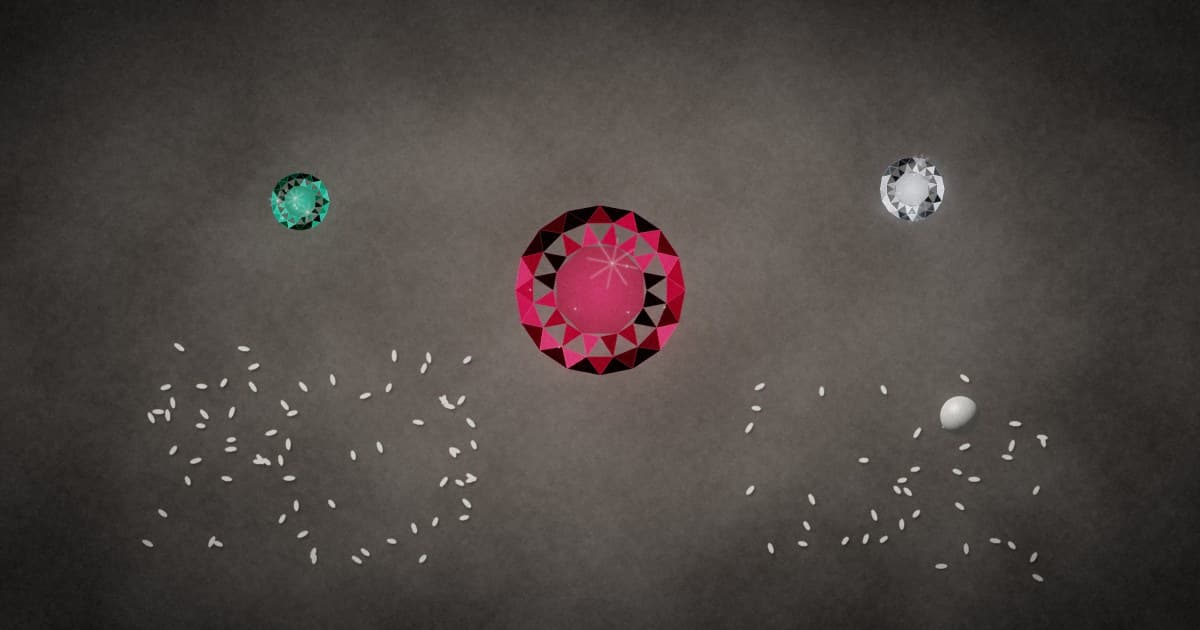
There were no carats. Gems were weighed against seeds: eight white mustard seeds made one rice grain. A diamond of 20 rice grains was valued at two lakh silver coins, one of 10 grains at forty thousand, and one of 2 grains at just two hundred. Value climbed steeply with size, as it still does.
Flawed stones lost value by a fixed fraction. This was a real market with real rules.
Pearls from eight shores
Pearls, he says, were said to come from elephants, serpents, conch shells, clouds, bamboo, whales and boars. These are the pearls of poetry. But he states plainly that the best pearls come from pearl oysters, and he names the fisheries:
- Sri Lanka: glossy, "swan-white" and large
- The Tamraparni river: white with a faint red tinge, and bright
- Saurashtra: medium-sized, with the lustre of butter
- Persia: lustrous, clear, heavy and very valuable
Pearls were also sold in lots by weight. Thirteen good pearls that together weighed one dharana had a special name, pikka. Smaller and smaller pearls had names of their own, down to churna, "dust".
What every good gem shares
In the ruby chapter, Varahamihira sums up what all excellent gems have in common:
"Smoothness, illumination with rays, purity, sparkle, heaviness, fine shape, brilliance within."
He also lists their defects: impure, dull, scratched, mixed with minerals, broken, badly drilled, unattractive or gritty. A ruby lacking colour fetched half the price. A dusky one, scratched and with few good features, fetched just a two-hundredth.
The emerald gets the shortest chapter and the loveliest description. The best is "of the hue of parrots' wings, bamboo leaves" or a banana stem, smooth and pure. It is "highly beneficial" when worn at ceremonies for the gods and the ancestors.
Why this still matters
Utpala's commentary draws the line to astrology directly. Gems are recommended to strengthen or calm the planets, he notes, but "all gems are not found to be satisfactory owing to their having some defects. Hence proper examination and trial of jewels are very essential."
That's the point many modern buyers miss. The classical tradition never said "any ruby will do". The quality of the stone was part of the remedy. A cloudy, cracked or treated stone wasn't a weaker remedy in this view. It was a risk.
So if you're thinking about a gemstone, the ancient advice comes in two steps. First, the right stone for your chart, chosen with care (the rules before you wear one). Second, a clean, natural, well-formed stone, examined as carefully as Varahamihira would have examined it.
The takeaway
Fifteen centuries ago, astrology and gemology sat side by side. Varahamihira's examiners checked hardness, lustre, fire, colour, weight and flaws, and they put the stone's quality on the same level as the planet it served. A good gem was thought to protect its wearer. A bad one was better left in the ground.
Calculate your chart free and ask Vedhora's astrologer which planet in your chart could use support, and whether a gemstone is the right remedy at all.
Discover Your True Planetary Placements
Calculate your true Sidereal Lagna, Chandra Rashi, Nakshatras, and 120-year Vimshottari Dasha timeline with verified astronomical precision.
Calculate Your Free Kundli