
What It Took to Be an Astrologer
Varahamihira's job description for an astrologer was brutal: astronomy, mathematics, observation, ethics and omens. The ancient syllabus, and his scorn.

Anyone can call themselves an astrologer today. In the sixth century, Varahamihira had a very different idea. The second chapter of his Brihat Samhita is called "Canons for the Astrologer", and it is the most demanding job description you are likely to read.
It's also a mirror. Read it, and you'll know exactly what to look for in an astrologer now.
First, the person
Varahamihira starts with character, not knowledge. An astrologer must be:
- Truthful, impartial and free from jealousy
- Clean, efficient, bold and eloquent, with ready wit
- A knower of time and place, and "not timid in assemblies"
- Free from vices, and devoted to worship, observances and fasting
- Able to answer questions and suggest remedies for troubles
Some of his list belongs to its age. He even wanted an astrologer to be well-built, with "a voice deep and sonorous". But the core is timeless. Your astrologer should tell the truth, take no sides, keep their composure and have something practical to offer.
His commentator adds one more line that deserves to be remembered: "a true astrologer must lead a life of contentment, detachment and contemplation."
Then, the mathematics
This is where the bar goes through the roof. Before he would trust anyone with a prediction, Varahamihira wanted them fluent in astronomy and calculation:
- Every unit of time, from the truti, a tiny fraction of a second, through the prana (one breath), the nadi (24 minutes) and the muhurta (48 minutes), up to the year and the yuga
- The five Siddhantas, the astronomical systems of his day: Paulisha, Romaka, Vasishtha, Saura (the Surya Siddhanta) and Paitamaha
- The four ways of measuring time: solar, civil (savana), sidereal and lunar, and why intercalary months and "lost" lunar days happen
- The sixty-year cycle, the five-year yuga, and the lords of every year, month, day and hour
- Why planets speed up, slow down and move north or south
- How to predict eclipses: when they start and end, which direction, how large, how long, how strong, and even what colour
- Latitude, the rising times of the signs at a given place, and how to turn a shadow's length into the time of day
Then, the eyes
Calculation alone wasn't enough. Varahamihira demanded that theory agree with observation. Where the Siddhantas disagreed about the solstice, the astrologer had to settle it with "the circle drawn on the ground by means of the shadow of the gnomon", together with water-clocks.
His promise is conditional:
"If an astrologer has mastered the astronomical Science, and has brought about perfect agreement between the mathematical results and observations made by means of the shadow of gnomon and the water-appliance, and is well established in the science of predictive astrology, his pronouncements will never go wrong."
The commentary on a later chapter puts the same spirit in a single sentence: "A true astronomer should not follow blindly the statements of ancient writers."
Then, the whole world
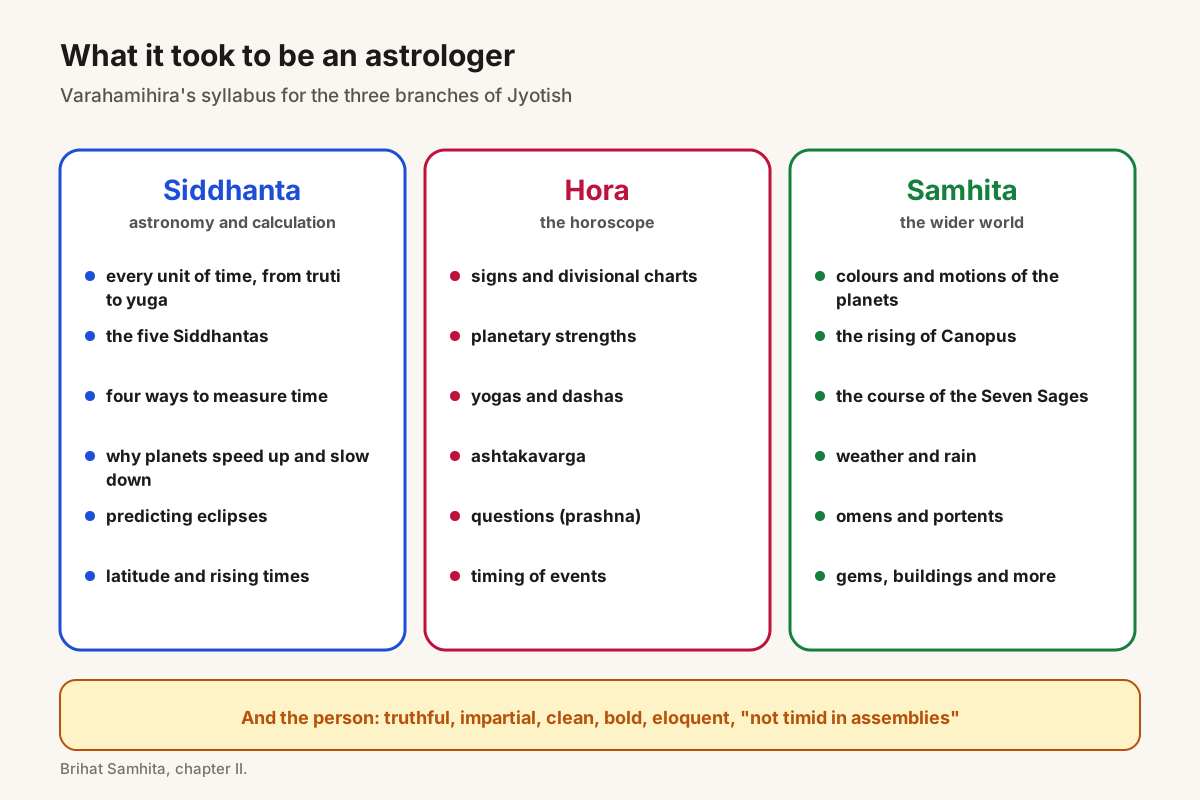
The astrologer also had to master all three branches of Jyotish:
- Siddhanta: astronomy and calculation
- Hora: the horoscope. This covers signs and divisional charts, planetary strengths, yogas, dashas, ashtakavarga, questions asked on the spot (prashna), and choosing auspicious times for rites such as marriage.
- Samhita: the wider world. This includes the planets' colours and motions, the rising of Canopus, the course of the Seven Sages, weather, earthquakes, omens and more.
He adds: "A true astrologer whose business is to divine man's fortune ... should also be a thorough scholar of the Samhita." A horoscope reader who knew nothing of the sky, the seasons and the world was, to him, only half-trained.
His contempt for quacks
Varahamihira didn't hide his anger at pretenders:
"If a person is unable to understand the real purport of the Science, nor to answer any question put to him, nor to explain the Science to his pupils, how could he be known as an astrologer?"
He calls someone who misreads the texts and miscalculates "an ignorant fellow", and adds a sarcastic simile too rude to repeat here. He quotes the sage Vishnugupta: a man might swim across the ocean with a good wind behind him, but no one who isn't a sage could "even dream of crossing the great ocean that is known as Kalapurusha", the ocean of Time.
Why it mattered so much
For Varahamihira, a good astrologer was a public good:
"Just as the night devoid of lights or lamps is utterly blind, and the sky without the Sun dark, even so will a king grope in life in the dark like a blind man on the way, if he is not guided by a good astrologer."
He goes further. Without an astrologer, he says, a king's muhurtas, lunar days, stars and seasons "would all be confused". And: "One who wishes for prosperity ought not to reside in a country which does not possess a good astrologer." The astrologer, in his phrase, is the eye of society.
What to look for today
Translate his canons into modern terms, and you get a simple checklist for anyone choosing an astrologer:
- Accuracy first. Is the chart calculated precisely: the right ayanamsa, the right time zone, the exact birth time?
- Reasoning you can follow. Can they explain why they say what they say, from the chart?
- Specific, timed statements rather than vague comfort or fear.
- Honesty and balance. No guarantees, no scare tactics, and remedies offered as support, not as a sales pitch.
- Humility. A willingness to check the theory against what actually happens in your life.
The takeaway
Varahamihira's astrologer was a mathematician, an observer, a scholar of the world and a person of character, all in one. The bar was high on purpose, because he believed the right guidance at the right time could steer a kingdom, or a life. Fifteen centuries later, his canons remain the best test of a reading: precise calculation, honest reasoning and close attention to reality.
Calculate your chart free and put Vedhora's astrologer to the test: ask a question, and ask it to show its reasoning. For the oldest roots of this tradition, read about the five-year yuga of the Vedas.
Discover Your True Planetary Placements
Calculate your true Sidereal Lagna, Chandra Rashi, Nakshatras, and 120-year Vimshottari Dasha timeline with verified astronomical precision.
Calculate Your Free Kundli