
Finding Water by the Trees
Fifteen centuries ago Varahamihira wrote a field guide to finding groundwater by reading trees, ant-hills, soil and stones. Inside his chapter on water.
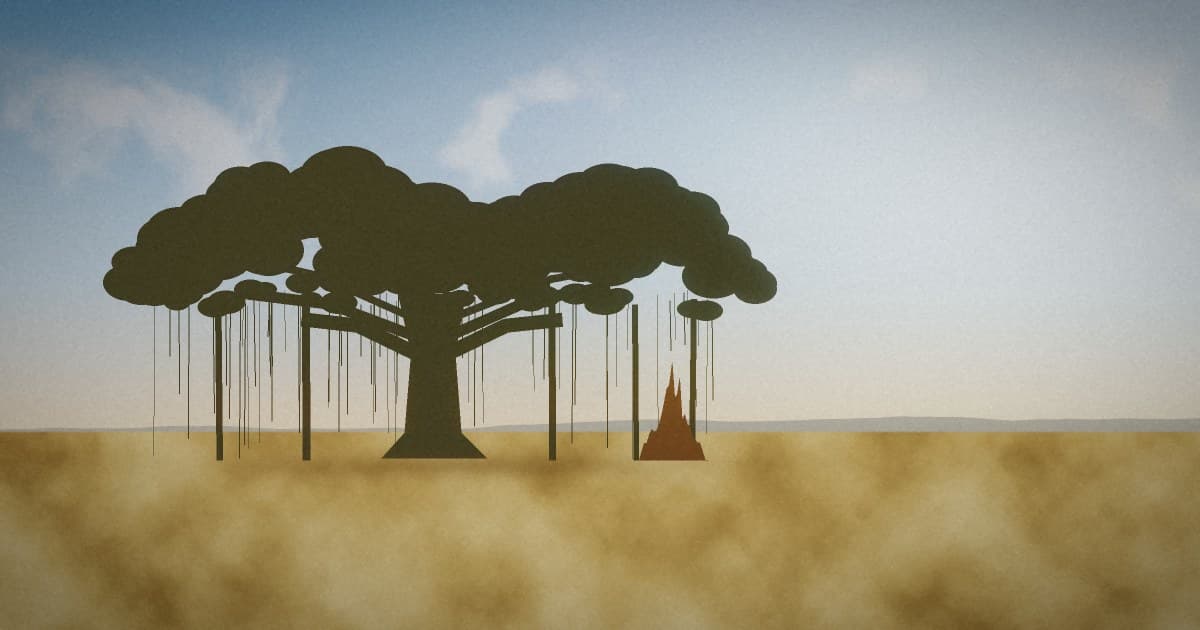
Picture a dry plain in sixth-century India. There's no river in sight and the last rains are months away. A village needs a well, and digging in the wrong place costs weeks of labour. So who do you call?
According to Varahamihira, you call someone who can read the ground. His encyclopedia, the Brihat Samhita, gives a whole chapter to it. The chapter is called Dakargala, and it's one of the most surprising things ever written by an astrologer.
Water locked in the earth
The name says it all. Daka is short for udaka, water, and argala means a bolt or bar. Dakargala is the science of water bolted away underground, and of how to find the bolt.
Varahamihira opens with an image that would fit a medical text:
"Just as there are veins in the human body, even so do they exist, some higher up, others lower down, in the earth."
Rain falls with one colour and one taste, he says, but it picks up different colours and tastes from the soil it sinks into. So water has to be judged by its surroundings. He even names the veins. Each of the eight directions has its own vein, called after the god who guards that quarter: Indra in the east, Varuna in the west, and so on. A ninth, the Great Vein, runs in the centre. Veins rising from the deep and those in the four main directions are good. Those in the corner directions are not.
Read the trees
Then comes the heart of the chapter: a long, precise list of signs. Each one names a tree, often with an ant-hill (a termite mound) nearby, and says exactly where to dig and how deep. Distances are in cubits, about a forearm's length.
- A Jambu tree in dry country: water 10 cubits down, 3 cubits north of the tree. At 5 cubits the earth smells of iron. Then comes pale white clay, then a frog.
- A Jambu with an ant-hill to its east: sweet water 10 cubits down, 3 cubits south of the tree. You'll pass fish at 2½ cubits, then a dove-coloured stone and blue clay, and below that water that lasts "for a long time".
- An Indian fig (banyan): good water at 12½ cubits, 3 cubits to the west.
- An Arjuna tree with an ant-hill to its north: water at 17½ cubits, under bands of grey, dark, yellow and white clay and then sand.
- A Nirgundi bush grown over by an ant-hill: "sweet and never-failing water" at 11½ cubits.
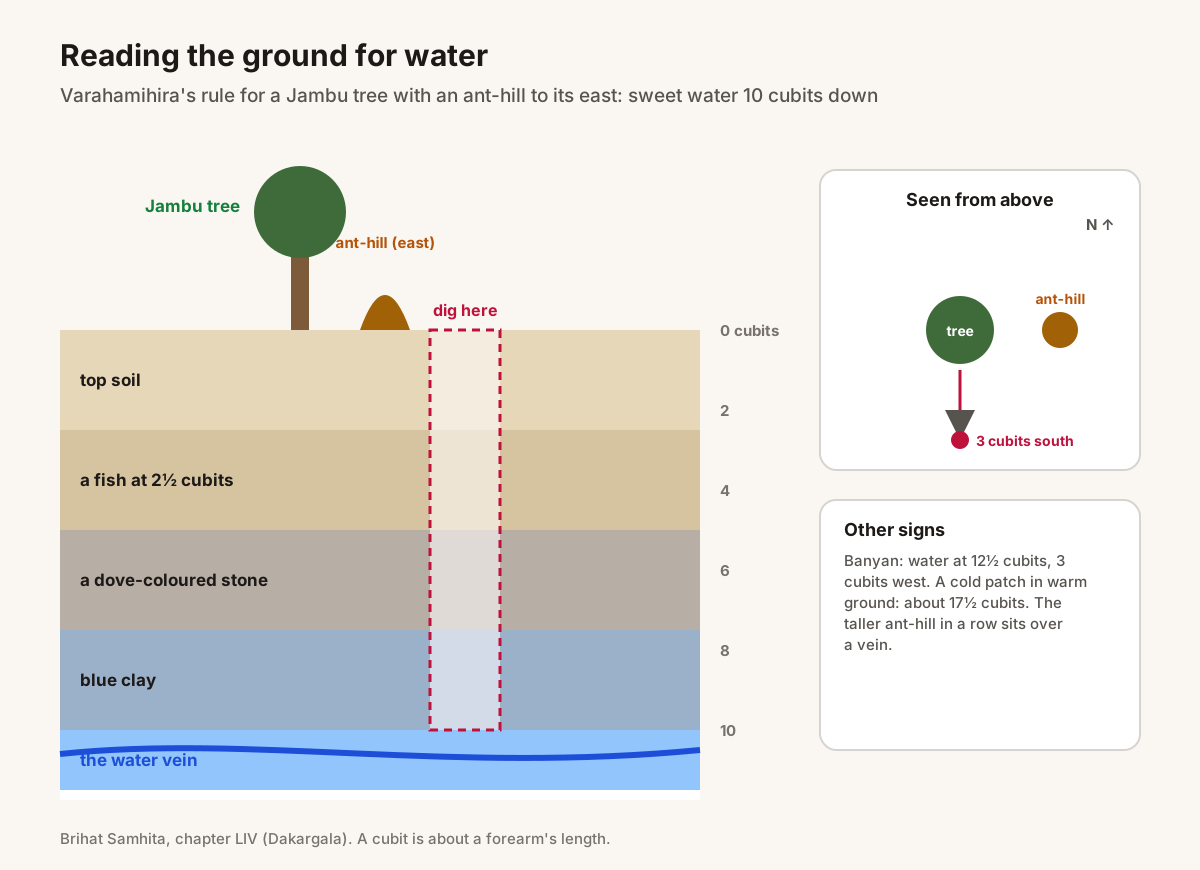
Notice what each entry gives the digger. It isn't a vague promise. It's a sequence of checkpoints: a creature, a clay, a stone. If they turn up in the right order, you're on the vein. If they don't, stop digging. It reads more like a geological log than a prophecy.
Read the land itself
Trees are only the start. The chapter teaches you to notice anything slightly out of place:
- A cold patch in warm ground, or a warm patch in cold ground, means water about 17½ cubits down.
- Ground that sinks underfoot, or insects swarming with no nest, means water about 7½ cubits down.
- In a row of ant-hills, the one that stands taller has a vein beneath it.
- So does a spot where plants wither or refuse to sprout.
- Glossy, dense, unholed leaves mean water is near. Coarse leaves "full of holes" mean it's far away.
Varahamihira also adjusts for climate. A sign seen in a semi-desert means the depth should be doubled compared with well-watered country. In true desert the depths grow further still.
Even the soil's colour has a taste
This is the part that stops modern readers in their tracks. The colour of the earth, he says, predicts the taste of the water:
- Blue earth gives sweet water.
- Copper-coloured earth with gravel gives astringent water.
- Red-brown earth makes it brackish.
- Pale white earth produces salty water.
- Land coloured like the Sun, fire, ashes, a camel or a donkey is waterless.
Rocks get the same treatment. Stones the colour of beryl, cloud or ripe figs mean abundant water nearby. Stones the colour of pigeons, honey or ghee "yield soon inexhaustible water."
And if the rock won't break?
The chapter ends with engineering. If a rock won't yield to the hammer, light a fire on it with Palasha and Tinduka wood until it glows red. Then sprinkle it with lime water. Other recipes use decoctions of plant ashes or fermented mixtures poured onto the heated stone again and again. It's the old method of cracking rock with heat and sudden cooling, written down in verse.
Why is this in an astrology book?
Because for Varahamihira, Jyotish covered far more than birth charts. The tradition has three branches. Siddhanta is astronomy and calculation. Hora is the horoscope of a person. Samhita is the study of signs in the wider world: weather, crops, earthquakes, omens and, yes, water. The Brihat Samhita is the great Samhita text, and a complete astrologer was expected to know all three (what that training demanded).
He's also honest about his sources. He says he studied the work of the sage Sarasvata, and then repeats the subject in a second metre "as taught by Sage Manu". Nothing here is invented on the spot. It's knowledge collected, checked and handed down.
The takeaway
The thread running through Dakargala is the same one that runs through all good Jyotish: pay attention to signs and read them in context. A Jambu tree means one thing in wet country and another in the desert, just as Mars means one thing in the 10th house and another in the 8th. Varahamihira trained astrologers to look closely at the world. Fifteen centuries later, that habit is still the heart of a good reading.
For more of the Samhita's sky-watching, read can the stars forecast the monsoon? Or calculate your chart free and see the Hora branch at work on your own birth moment.
Discover Your True Planetary Placements
Calculate your true Sidereal Lagna, Chandra Rashi, Nakshatras, and 120-year Vimshottari Dasha timeline with verified astronomical precision.
Calculate Your Free Kundli