
How a Dasha Unfolds: Start, Middle, End
A planetary period isn't uniform. What comes early and late in a dasha, the chart cast at its start, and why some periods end better than they begin.

"I've been in Saturn's period for six years. Why has it changed so much?" It's one of the most common questions astrologers hear. A mahadasha can last up to twenty years, and it rarely feels the same at the end as at the start.
The classical texts knew this. They give rules for what a planet delivers first, what it delivers later, and how to tell whether a period will open well. Here they are, simply.
The sub-periods set the rhythm
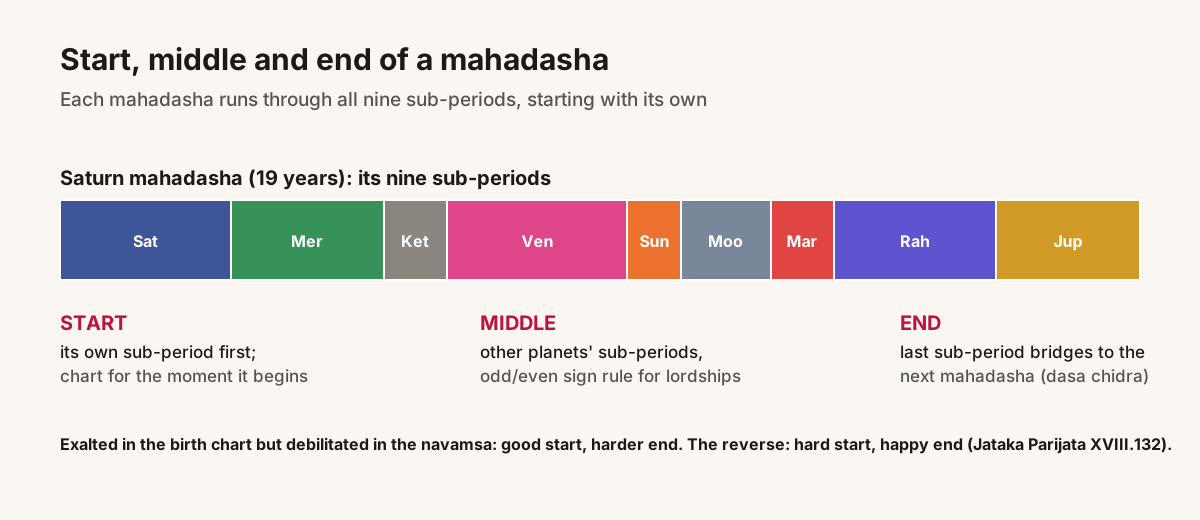
Every mahadasha begins with its own planet's sub-period (antardasha), then moves through the other eight in fixed order (how the periods are calculated).
- The opening: the planet's own sub-period gives its pure flavour. This is when you first feel a new chapter's character.
- The middle: sub-periods of other planets bring their own themes through the main planet's lens.
- The close: the last sub-period belongs to the planet just before the mahadasha lord in the cycle. B.V. Raman's glossary calls the end of a dasha the dasa chidra, the "gap" or opening at its edge, where one chapter thins into the next.
Which results come first: the odd and even sign rule
Most planets rule two houses. So which house shows up first in their period?
B.V. Raman, commenting on the Bhavartha Ratnakara (stanzas 10–11), gives an elegant rule:
- A planet in an even sign gives the results of its trinal lordship first (the 1st, 5th or 9th house it rules), and its other lordship later.
- A planet in an odd sign gives the results of its other lordship first, and its trinal lordship later.
His example: Venus in an odd sign, ruling a kendra (the 4th) and a trine, gives the results of the kendra at the start of its period, while the results of the trine come "afterwards, in the middle and last parts."
So a single planet can open one door early in its period and another late.
The chart for the moment a dasha begins
Jataka Parijata (XVIII.6–8), drawing on Sripati, adds a powerful technique: cast a chart for the moment the dasha starts, and read it.
- If the dasha lord is in that moment's lagna, or in the 3rd, 6th, 10th or 11th from it, the period "will prove auspicious."
- The same holds if the rising sign belongs to the dasha lord's own divisions (hora, drekkana, saptamsa, navamsa, dwadasamsa or trimsamsa), or if a friendly or benefic planet is rising.
- The Moon at the start of the dasha matters too. If it's in a friend's sign of the dasha lord, in the dasha lord's exaltation sign, or in the 7th, a trine or an upachaya house from it, it "produces beneficial effects." The house its sign represents in your birth chart prospers in that period.
Astrologers today often call this a dasha pravesha chart, the chart of entry into a period. It's like reading the weather on the first morning of a long journey.
Periods that end better than they begin
The navamsa adds one more timing rule. Jataka Parijata (XVIII.132) describes a planet whose strength differs between the birth chart and the navamsa (what the navamsa shows):
- Exalted in the birth chart but debilitated in the navamsa: happiness at the start of its dasha, with trouble towards the end.
- Debilitated in the birth chart but exalted in the navamsa: hardship at the start, sometimes rivals, losses and wandering, but a happy end.
That's the classic shape of a late bloomer. If your period started badly, check the planet's navamsa. The second half may be very different (when a fallen planet rises).
Reading your own period
Put it together with five questions:
- Which houses does the dasha lord rule, and is it in an odd or even sign? That tells you which results arrive first.
- Where is it in the navamsa? If its strength changes between charts, expect the period to change too.
- Which sub-period are you in? Your current antardasha lord's houses are what you're living now.
- What did the sky look like when the period began? A strong dasha lord at the start of its own period is a good omen.
- How close is the end? The last sub-period is a bridge. Start preparing for the next planet's themes.
An example from the texts
Jataka Parijata describes Jupiter's sub-period within Saturn's dasha: "devotion to Gods and Brahmanas, royal favour, great happiness and attainment of rank." Saturn's long, demanding period can contain bright stretches. A whole mahadasha isn't one colour. It's a sequence of moods, and the texts give you the means to read each one.
The takeaway
A dasha is a story with a beginning, a middle and an end. Odd and even signs decide which of a planet's houses speak first. The chart at the start of a period sets its tone. The navamsa can turn a hard opening into a strong finish. Knowing this won't make a hard period easy, but it will tell you when it's likely to turn.
Calculate your chart free and ask Vedhora's astrologer where you are in your current dasha, and what the coming sub-periods bring.
Discover Your True Planetary Placements
Calculate your true Sidereal Lagna, Chandra Rashi, Nakshatras, and 120-year Vimshottari Dasha timeline with verified astronomical precision.
Calculate Your Free Kundli