
Graha Yuddha: When Planets Go to War
When two planets come within a degree, Jyotish calls it a planetary war. The four kinds Varahamihira described, how the winner is judged, what it means.
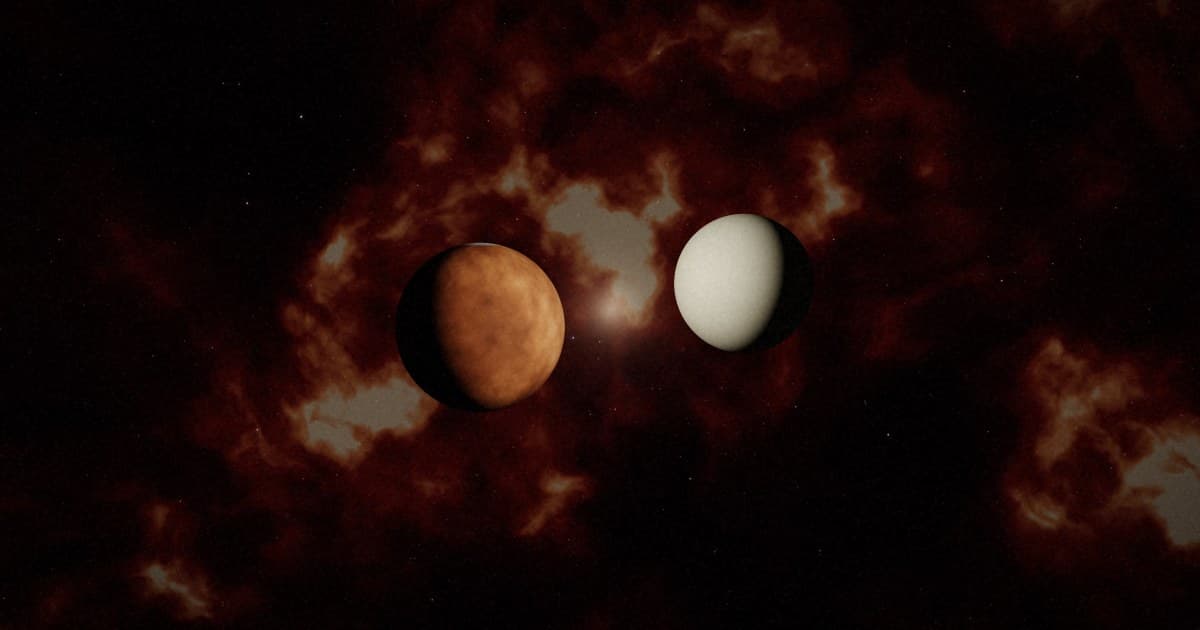
Two planets in the same sign are said to be "in conjunction", sharing a house and blending their energies. But when two planets come very close, within about a degree, the classical astronomers saw something more dramatic. They called it graha yuddha: planetary war.
It sounds mythological. It began as careful observation of the night sky.
What Varahamihira saw
Chapter 17 of Varahamihira's Brihat Samhita is devoted entirely to planetary war. He explains the cause like an astronomer:
When the planets move in the sky along their orbits lying over one another, they appear to our eyes to move on even surface or plane, as a result of their great distance.
Planets on very different orbits look, from Earth, as though they are touching. Varahamihira notes that he had already worked out how to calculate these meetings in his astronomical treatise, the Panchasiddhantika, on the basis of the Surya Siddhanta.
The four kinds of war
Following Parashara and other sages, Varahamihira lists four types, by how closely the two discs meet:
- Bheda (piercing): one planet completely covers the other.
- Ullekha (grazing): their rims touch.
- Amshumardana (clashing rays): they're so close their rays seem to fight.
- Apasavya (passing to the south): one passes close by on the southern side.
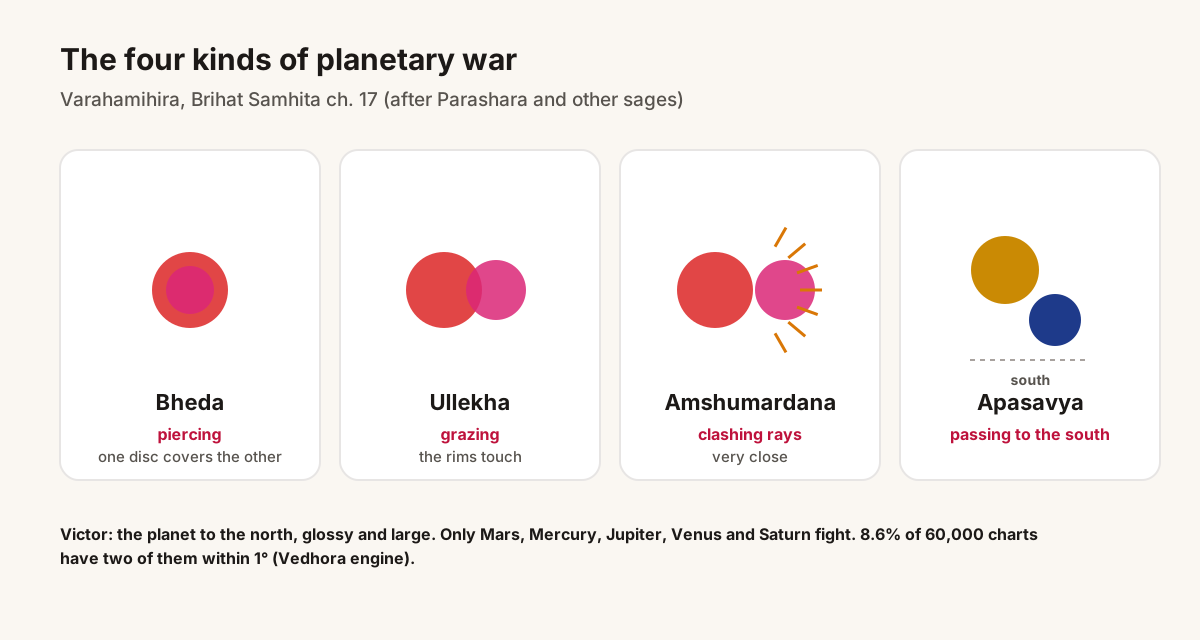
The commentator quotes the scholar Kern: the conflict happens "when the interval is somewhat less than a degree; at a greater interval there is no conflict." That one-degree rule is how most astrologers define graha yuddha today.
Who fights
Only the five "star-planets" go to war: Mars, Mercury, Jupiter, Venus and Saturn. When a planet comes close to the Sun, it's combustion, not war (combust planets). The Moon's close meetings with planets are treated separately as samagama, union. Rahu and Ketu don't fight.
How the winner is decided
Varahamihira lists the signs of defeat: being to the south of the other planet, looking rough, trembling, losing colour or brightness, appearing small, or seeming to retreat. The victor is to the north, glossy and large. Even a planet on the southern side is declared the winner if it shows the marks of victory.
So the classical test is about latitude and brightness: the planet that is further north and shines brighter wins. Jataka Parijata adds that planets moving retrograde are counted as victorious (why retrograde means strength).
Some modern textbooks use simpler rules. Fundamentals of Vedic Astrology, for example, treats the planet in the earlier degree of longitude as the conqueror. In the detailed Shadbala calculation, the winner takes a share of strength from the loser, called yuddha bala, war strength.
What it means in a chart
Planetary war is weighed seriously because the defeated planet is badly weakened. Varahamihira, in his work on travel and timing (Yatra), says that planets in depression, defeated in war or lost in the Sun's rays "become incapable like snakes" struck down. Jataka Parijata repeatedly lists "overcome in planetary war" alongside debilitation and combustion as a sign of a planet that can't deliver.
In practice:
- The winner dominates. Its themes take the lead in the area of life where the war happens.
- The loser struggles. The houses it rules and the people it signifies may suffer, or give results only with great effort.
- Their periods show it. The dasha of the defeated planet often brings the matters it rules into conflict, and the winner's dasha can bring triumph at the loser's expense.
For example, Venus and Mars at war in the 7th: if Mars wins, passion and conflict may overpower harmony in partnership. If Venus wins, attraction smooths over the friction. Jupiter defeated by Saturn might mean faith and teachers come under pressure from duty and hardship before wisdom returns.
How common is it?
Closer than one degree sounds rare, but there are five planets that can fight. In 60,000 charts we ran through Vedhora's engine, 8.6% contained a graha yuddha between two of Mars, Mercury, Jupiter, Venus and Saturn. That's roughly one person in twelve.
In the world, too
The Brihat Samhita is also a book of mundane astrology, astrology of nations and nature, and it ties each kind of war to collective events. Bheda brings failed rains and discord among families. Ullekha brings clashes of arms and quarrelling ministers. Amshumardana brings wars, disease and scarcity. Apasavya sets kings against each other. The same lens that reads a single life was turned on whole kingdoms.
The takeaway
Graha yuddha is a reminder of how closely the ancient astrologers watched the sky. Two planets within a degree are not just "together". One is winning. If your chart has a planetary war, the question is which planet comes out on top, and what each one rules for you.
Calculate your chart free and ask Vedhora's astrologer whether any of your planets are at war, and who wins.
Discover Your True Planetary Placements
Calculate your true Sidereal Lagna, Chandra Rashi, Nakshatras, and 120-year Vimshottari Dasha timeline with verified astronomical precision.
Calculate Your Free Kundli