
The Five Mahapurusha Yogas
Ruchaka, Bhadra, Hamsa, Malavya and Sasa: the five 'great person' yogas, how each forms, which ascendants get them, and why a weak planet gives only the name.
Of all the yogas in Jyotish, five carry a special title: Pancha Mahapurusha, the yogas of the five great persons. Varahamihira praised them in his Brihat Samhita, and almost every classical text repeats them. Each one belongs to one planet, and each describes a distinct kind of greatness.
They are also easy to misread. Here is how they form, what they promise, and how to tell a real Mahapurusha Yoga from one in name only.
The rule behind all five
The formula is the same for each:
A planet in a kendra (the 1st, 4th, 7th or 10th house) in its own sign or its exaltation sign.
Only the five "true" planets qualify: Mars, Mercury, Jupiter, Venus and Saturn. The Sun and Moon don't form Mahapurusha yogas, and neither do Rahu and Ketu.
A kendra is a pillar of the chart, where planets act most visibly. Put a planet there at full dignity, and its nature becomes a defining feature of the person.
The five great persons
These descriptions follow B.V. Raman's Three Hundred Important Combinations, which gathers the classical results.
Ruchaka Yoga (Mars). Mars in Aries, Scorpio or Capricorn in a kendra. Strong build, courage, fame, knowledge of tradition, a charitable streak, wealth, long life and the bearing of a leader: "king or equal to a king" and the head of an army. Today that reads as command, sport, surgery, engineering, defence.
Bhadra Yoga (Mercury). Mercury in Gemini or Virgo in a kendra. A strong, well-proportioned body, sharp intelligence, a reserved way of speaking, help given to relatives, a long life. This is the yoga of the analyst, writer, trader and advisor.
Hamsa Yoga (Jupiter). Jupiter in Sagittarius, Pisces or Cancer in a kendra. Good looks, likeability, a righteous disposition and, above all, a pure mind. The teacher, counsellor, judge or guide.
Malavya Yoga (Venus). Venus in Taurus, Libra or Pisces in a kendra. A well-developed physique, a strong mind, wealth, happiness with spouse and children, vehicles, refined senses, learning and renown. The artist, designer, diplomat, or anyone who makes life beautiful.
Sasa Yoga (Saturn). Saturn in Capricorn, Aquarius or Libra in a kendra. Command over people and resources, and leadership of a village, a town, or more. Raman notes the texts also warn of a hard, self-serving streak. Sasa is power earned through endurance and structure, and how it is used matters.
Not every ascendant can have every yoga
This surprises people. Because the yoga needs a specific sign to fall in a kendra, your ascendant decides which ones are even possible:
- Movable ascendants (Aries, Cancer, Libra, Capricorn) can have Ruchaka, Hamsa, Malavya and Sasa.
- Fixed ascendants (Taurus, Leo, Scorpio, Aquarius) can have Ruchaka, Malavya and Sasa.
- Dual ascendants (Gemini, Virgo, Sagittarius, Pisces) can have Hamsa, Bhadra and Malavya.
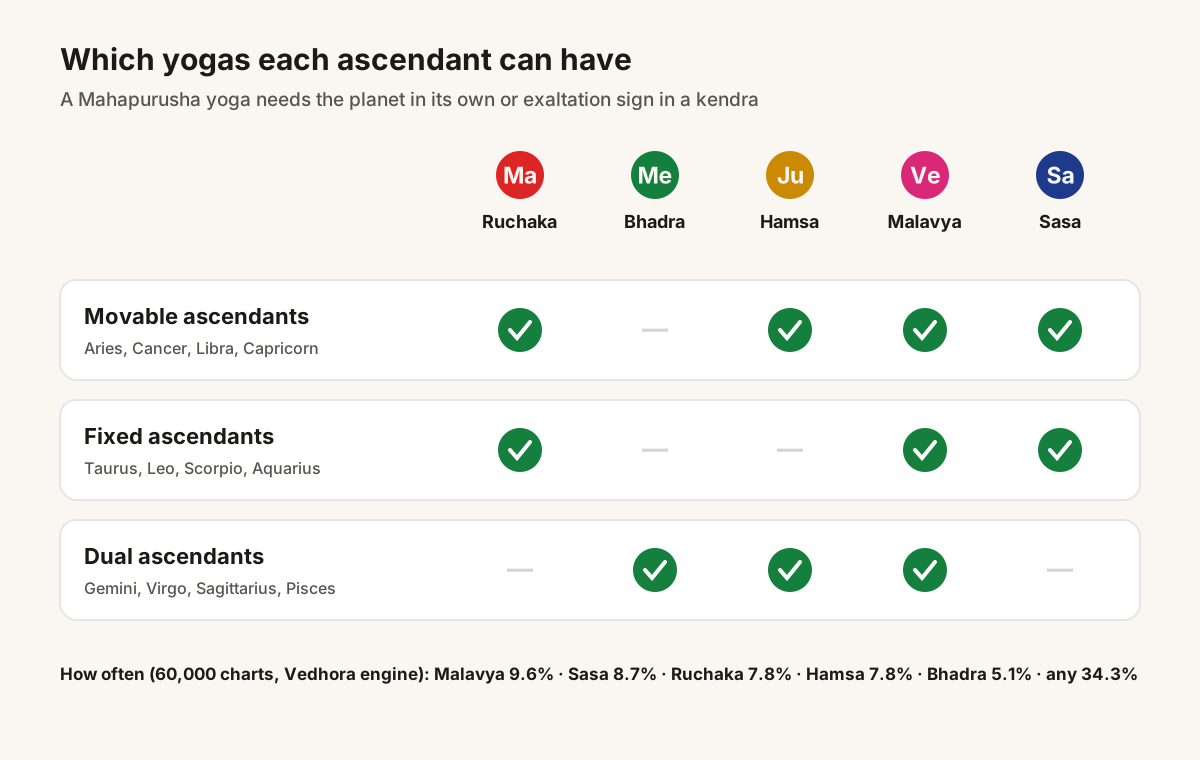
Malavya is the only one possible for every ascendant. Bhadra is possible only for dual ascendants. If you have a Taurus ascendant, no reading can honestly give you Hamsa Yoga.
How common are they?
We ran 60,000 birth charts through Vedhora's calculation engine and counted:
- Malavya: 9.6% of charts
- Sasa: 8.7%
- Ruchaka: 7.8%
- Hamsa: 7.8%
- Bhadra: 5.1%
- At least one of the five: 34.3%
So roughly one person in three has a Mahapurusha Yoga by definition. That's far too many "great persons", which tells you the definition alone isn't enough.
De facto, not de jure
Raman makes the decisive point. The Pancha Mahapurusha yogas "can be said to exist only when the planets concerned are strong and full of vitality." The texts use the word balishta, very strong. If the planet is weakened by combustion, by an affliction or by a bad position in the navamsa, the yoga "does not operate in its real sense, though nominally, it may exist." He calls the strong kind de facto and the weak kind only de jure.
So look for:
- Clean strength. The planet isn't combust (why that matters), isn't badly aspected by malefics, and isn't weak in the navamsa.
- A good house role. A Mahapurusha planet that rules your 6th, 8th or 12th from the lagna may give greatness through struggle, service or hidden work.
- Its own period. The yoga shows most clearly in the dasha of that planet.
What it means for you
If you have a real Mahapurusha Yoga, that planet's quality is your signature strength. Build on it on purpose. A Ruchaka native does well with challenge and physical discipline, a Hamsa native with teaching and principle, a Malavya native with beauty and relationship. A Bhadra native should think, write and trade, and a Sasa native should build things that last.
If the yoga is only nominal, don't feel cheated. A planet in its own sign in an angle is still a planet at home and in the open. It is simply waiting for its strength to be developed rather than handed to you.
The takeaway
The Mahapurusha yogas describe five types of excellence, each tied to a planet at full strength in a pillar of the chart. They're common by definition and rarer in their full form. The difference lies in the planet's real strength.
Calculate your chart free to see whether you have one, and ask Vedhora's astrologer whether it is the real thing. For another famous yoga with the same caveat, read Gaja Kesari Yoga: the fine print.
Discover Your True Planetary Placements
Calculate your true Sidereal Lagna, Chandra Rashi, Nakshatras, and 120-year Vimshottari Dasha timeline with verified astronomical precision.
Calculate Your Free Kundli