
The Seven Sages in the Sky
The Big Dipper is India's Saptarishi: seven sages circling the Pole Star, with Arundhati beside Vasishtha. Their names, the 2,700-year cycle and their omens.

Go outside on a clear spring evening in India, look north, and you'll find seven bright stars in the shape of a ladle. In the West it's the Big Dipper, part of the Great Bear. In India, for thousands of years, it has been the Saptarishi, the Seven Sages.
Varahamihira loved them. The chapter he wrote on their course in the Brihat Samhita opens with some of his most affectionate poetry:
"...the Seven Seers (the Great Bear), through whom the northern region shines as though bedecked with a pearl necklace, like a maiden with a smiling countenance wearing a garland of white lotuses ... and by whose circular movements the northern quarter seems verily dancing at the instruction of the leader, viz., the Pole-Star."
The sages dance, and Dhruva, the Pole Star, leads. Watch through one night and you'll see it: the seven stars wheel slowly around a single fixed point, as if on a string.
Who's who among the stars
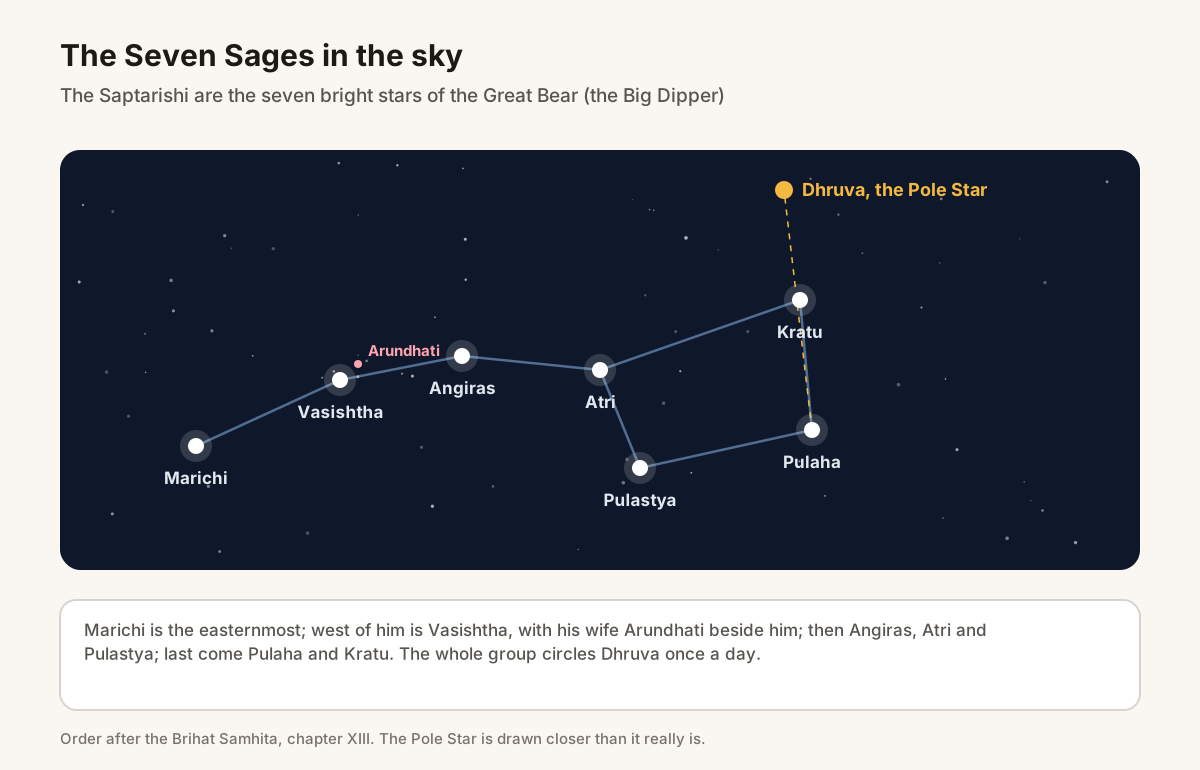
Varahamihira names them, following the senior sage Garga:
- Marichi is the easternmost.
- West of him is Vasishtha.
- Then come Angiras, Atri and, close by, Pulastya.
- Last come Pulaha and Kratu.
And there is an eighth light. Beside Vasishtha shines a faint companion, Arundhati, his wife, "the paragon of virtue". On a dark night you can see her as a tiny star right next to the bright one in the bend of the ladle's handle. Astronomers call the pair Mizar and Alcor.
Lists of the seven sages vary between texts. One tradition counts Bhrigu among them, the sage to whom the famous Bhrigu Samhita is attributed. But the image is the same everywhere: the wisest of the wise, keeping watch over the north.
A marriage in the stars
Arundhati's closeness to Vasishtha made the pair a symbol of a steady, faithful marriage. The Encyclopedia of Astrological Remedies describes the Arundhati Vrata, observed for a long married life. On the second day, small golden images of Dhruva, Vasishtha and Arundhati are installed and worshipped. Arundhati is honoured first and asked for the boon of the husband's long life, and then Vasishtha and Dhruva are worshipped.
The choice of stars is not an accident. The Pole Star never moves, and Arundhati never leaves Vasishtha's side. For a vow about steadiness and loyalty, you could not pick better witnesses.
A clock 2,700 years long
The Seven Sages also gave India one of its most intriguing calendars. Varahamihira records the teaching:
"The Sages traverse through each lunar mansion for a period of 100 years."
With 27 nakshatras, one full round takes 2,700 years. The sages are said to be "in" whichever nakshatra they appear to rise to the east of. Varahamihira adds a historical anchor: the Seven Sages were in Magha when King Yudhishthira ruled, and the Shaka era began 2,526 years after his reign.
This Saptarishi reckoning is a reminder that Indian timekeeping ran on many clocks at once: the Moon's month, the Sun's year, Jupiter's sixty-year cycle, and this slow, stately turn of the sages through the stars.
What their light foretold
Like all the stars of the Samhita, the sages were also watched for signs. When they look large and bright, the things in their care flourish. When they look pale, rayless or tiny, or are "attacked by meteors, thunderbolts, smoke and the like", those same things suffer.
Each sage looks after his own domain:
- Angiras: scholars, thinkers and the learned
- Atri: forest people, the ocean, rivers and everything that comes from water
- Pulaha: roots and fruits
- Kratu: sacrifices and those who perform them
- Vasishtha: hermits and forest-dwellers, and when he is radiant, he "bestows prosperity"
- Marichi: the celestial beings, along with spells and herbs
It's a lovely piece of sky-thinking. Each sage looks after part of the world, and you could read their well-being in their light.
Why the North mattered
In Indian thought, the north is the direction of stability and the gods. The Pole Star is its anchor: the one point that doesn't rise or set. The story of the child Dhruva, whose devotion won him a place as the unmoving star, made that point a symbol of steadfast faith. And the sages circling him are like wisdom orbiting truth.
Look up at them tonight and you're seeing the same picture that sages, poets and astronomers saw for millennia: the seven seers and the faithful Arundhati, turning patiently around the still centre of the sky.
The takeaway
The Saptarishi are more than a constellation. They're a calendar (one nakshatra per century), a set of omens (their brightness read for the welfare of their domains) and a lasting image of wisdom and fidelity, with Arundhati beside Vasishtha and all of them circling Dhruva. Varahamihira saw a pearl necklace. On your next clear night, see if you can spot Arundhati.
For the great star of the opposite horizon, read about Agastya, the star that clears the water. To find your own place among the stars, calculate your chart free and look up your birth nakshatra.
Discover Your True Planetary Placements
Calculate your true Sidereal Lagna, Chandra Rashi, Nakshatras, and 120-year Vimshottari Dasha timeline with verified astronomical precision.
Calculate Your Free Kundli