
Mount Meru and the Shape of the Cosmos
A golden mountain at the world's centre, ring-shaped continents and oceans of milk. The Puranic cosmos explained, and why astronomers read Meru as the Pole.
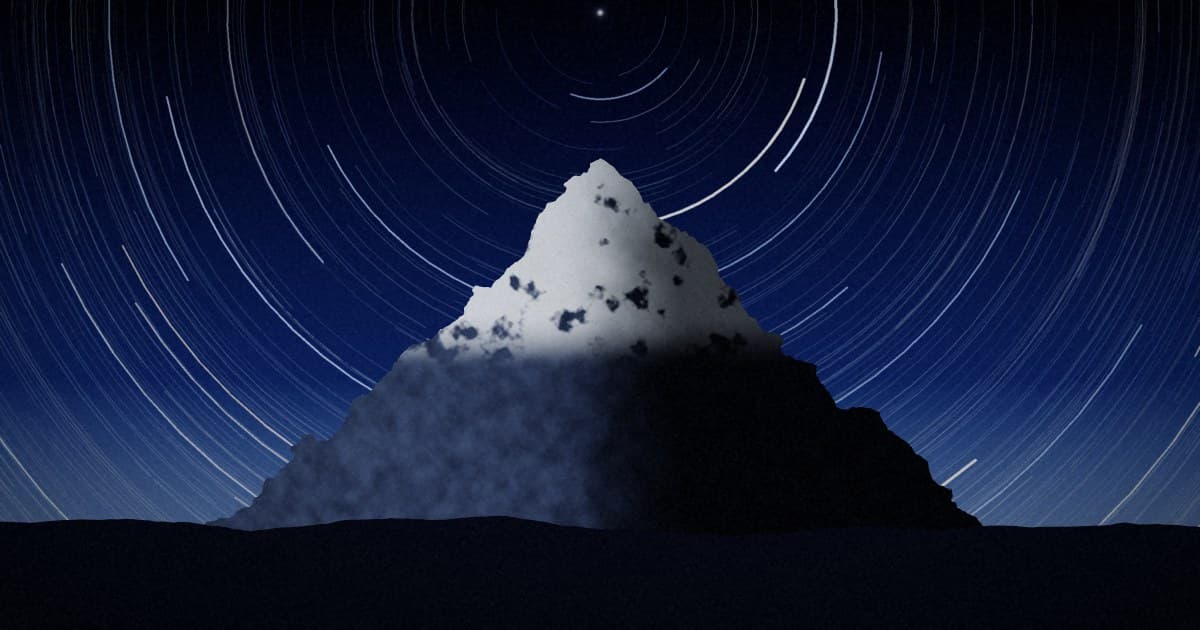
Every great tradition has a picture of the whole world. India's is one of the most extraordinary ever drawn. It has a golden mountain at the centre, ring after ring of island-continents and oceans spreading outward, and the Sun's chariot sweeping around the peak.
At the heart of it stands Mount Meru. To understand Meru is to understand how the old astronomers and the old storytellers saw the shape of everything.
The disc of the world
Richard L. Thompson's Vedic Cosmography and Astronomy lays out the picture given in the Fifth Canto of the Bhagavata Purana. Our universe, the brahmanda, is pictured as one bubble among countless others floating in a vast ocean. Inside it, the most striking feature is Bhu-mandala, the "earth circle": a vast flat disc.
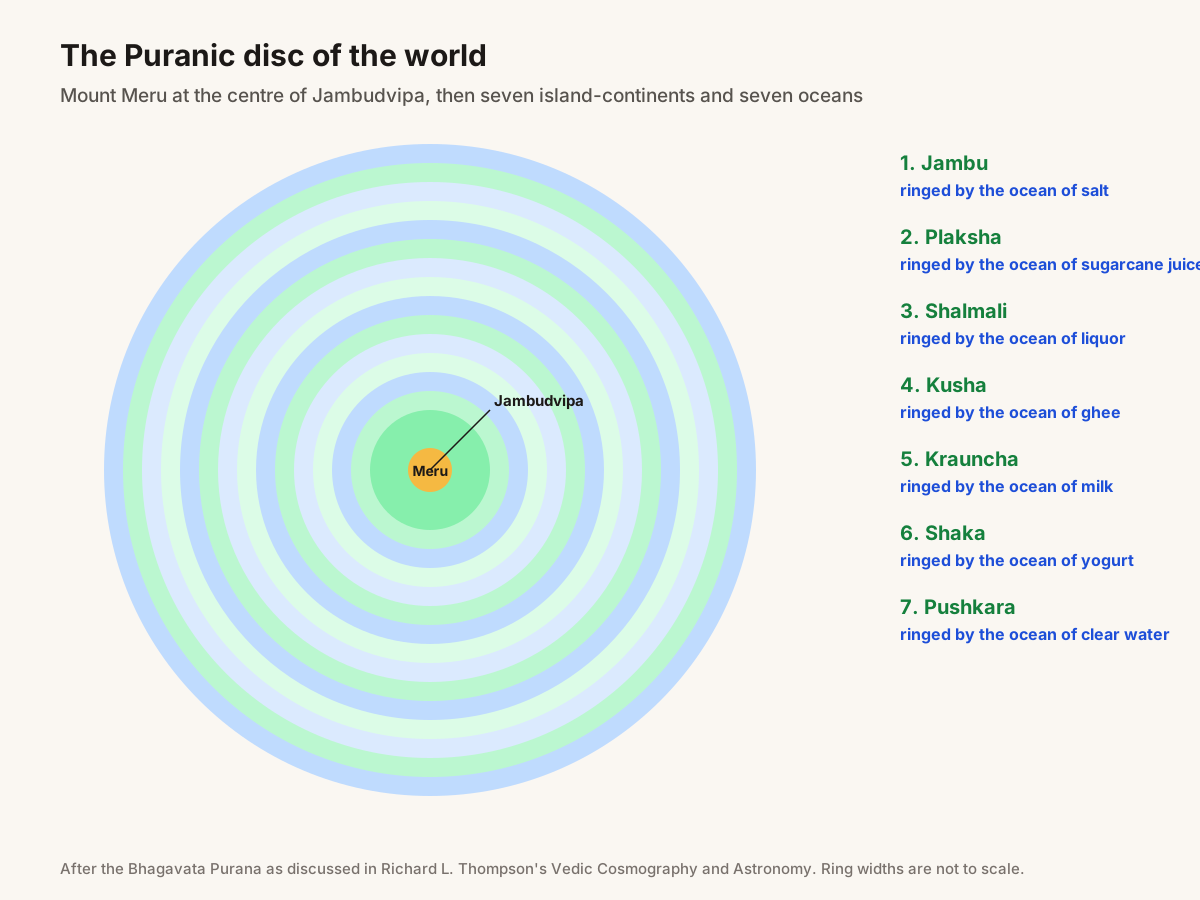
The disc is laid out like a target:
- At the centre is the round island of Jambudvipa, 100,000 yojanas across.
- Around it, in rings, come seven dvipas (island-continents), with seven oceans between them. Each ring is wider than the one inside it. Going outward from Jambudvipa: Plaksha, Shalmali, Kusha, Krauncha, Shaka and finally Pushkara.
- The oceans are famous for their names. Besides the salt ocean, there are oceans of sugarcane juice, liquor, ghee, milk, yogurt and clear water. They're celestial counterparts, Thompson stresses, of the everyday substances.
And at the exact centre of Jambudvipa rises Meru, 84,000 yojanas high. On its summit is Brahmapuri, the city of Brahma, surrounded by the cities of eight other gods. It's the axis of the world.
Why the numbers are so big
Read the measurements and something odd jumps out. The mountains of Bhu-mandala are thousands of miles high. The whole disc, in Thompson's conversion, is billions of miles across. These aren't the dimensions of the Himalayas. They're on the scale of the planets' orbits.
Thompson suggests the Bhagavata's account isn't describing the ground beneath our feet at all. It's describing a cosmic structure "built on the scale of the solar system". Seen this way, the disc of Bhu-mandala corresponds to the plane in which the Sun and planets move, the band of sky we call the ecliptic. He calls these readings hypotheses, and he works through them carefully. But they show how the picture can be read on more than one level.
The Sun's road around Meru
The Bhagavata places the Sun's path on a great ring-shaped mountain called Manasottara, which circles Meru. The Sun's chariot travels around it in an orbit called Samvatsara, "the year".
The Sun's movement north and south is described in terms of Meru too. As Thompson quotes, "the sun moves for six months on the northern side of Sumeru Hill and for six months on the southern side." Those two half-years are the Uttarayana and Dakshinayana, the Sun's northern and southern journeys (read more about them). They're also why summer in one hemisphere is winter in the other.
And everything turns around a single point. In the Puranic picture, the stars and planets wheel daily around "a fixed axis that extends from Mount Meru through the polestar", the star of Dhruva.
Meru as the North Pole
Here's where the storytellers and the astronomers meet. The mathematical astronomy texts, the Siddhantas, treat the Earth as a globe, and they place Meru on it. As Thompson notes, the Surya Siddhanta "describes Mount Meru as a small mountain at the North Pole," and the Siddhanta Shiromani places the seven dvipas in the southern hemisphere.
Think about what that means. At the North Pole, the pole star stands straight overhead, and the whole sky wheels around it, just as everything wheels around Meru. The Sun stays up for six months and then sets for six months. It's the one place on Earth where the Puranic image of a world-axis becomes literally true.
So Meru works at every scale: the centre of the cosmic disc, the axis of the turning sky, and the pole of the spinning Earth.
Meru in astrology's own stories
Jyotish keeps returning to Meru as the place where knowledge begins. In the Brihat Samhita, Varahamihira traces his teaching on the Rohini yoga, the great monsoon forecast, back to Brihaspati instructing the sage Narada in a celestial garden on the summit of Meru. The guru of the gods teaches the science of the sky from the top of the world.
It's a fitting image. From the top of Meru, the whole wheel of the heavens turns around you.
How to read a cosmos like this
It's tempting to ask whether this picture is "right". The more useful question is what it's for. The Puranic cosmos describes the universe the way a mandala describes the mind: as an ordered, centred, sacred whole. The Siddhantas describe the measurable sky, with a round Earth, a pole and computable orbits. Thompson's work shows the two can be laid side by side, each true to its purpose.
Your birth chart works the same way. It's a precise astronomical snapshot, and it's also a map with a centre, the ascendant, around which your life turns.
The takeaway
Mount Meru is the still centre of the Indian cosmos. In the Puranas it rises from Jambudvipa, ringed by seven continents and seven oceans, with the Sun's chariot circling it once a year. In the Siddhantas it becomes the North Pole, where the sky turns around the pole star and the Sun shines for six months at a time. Myth, cosmology and astronomy all point to the same place: the axis around which everything turns.
For the age of the world in this cosmos, read when did Kali Yuga begin? Or find the centre of your own chart: calculate your chart free.
Discover Your True Planetary Placements
Calculate your true Sidereal Lagna, Chandra Rashi, Nakshatras, and 120-year Vimshottari Dasha timeline with verified astronomical precision.
Calculate Your Free Kundli