
Yogini Dasha: When Two Clocks Agree
Your chart runs two dasha clocks at once: Vimshottari and the 36-year Yogini cycle. What each of the eight yogini periods tends to bring, and why the years when both clocks agree matter most.
Most people who have had a Vedic reading know their Vimshottari dasha: the long planetary periods, Saturn for 19 years, Venus for 20, that frame a life in chapters. Fewer know that the same birth chart also runs a second, faster clock, the Yogini dasha, a 36-year cycle of eight periods named after goddesses.
Our tutorial explains how the Yogini dasha is calculated from your birth star. This article is about what comes after the arithmetic: what each yogini period tends to feel like, why the same period differs from one chart to another, and why astrologers pay the most attention to the years when the two clocks agree.
Two clocks from one Moon
Both systems start from the same point: the Moon's nakshatra at the moment of birth, and how far the Moon had travelled through it. From there they run at very different speeds.
- Vimshottari is a 120-year cycle of nine planets. Its chapters are long, from 6 to 20 years.
- Yogini is a 36-year cycle of eight yoginis. Its chapters last from 1 to 8 years, so most people pass through more than one full round in a lifetime.
Because they move at different speeds, the two clocks drift in and out of step. Sometimes they point to unrelated planets. Sometimes, for a few years, they run the same planet at once. Those overlaps are where the timing becomes most dependable.
The eight periods and what they tend to bring
The yoginis follow a fixed order, each with a planetary lord. Tradition gives each a broad character, which its name already hints at:
- Mangala (the Moon, 1 year), "auspicious": a short, usually easy period. Comfort, goodwill, things settling down.
- Pingala (the Sun, 2 years), "tawny": mixed. Pressure from authority or elders, strain on health or the heart, and also ambition and visibility.
- Dhanya (Jupiter, 3 years), "blessed, wealthy": growth, support from teachers and family, money and opportunities that arrive more readily.
- Bhramari (Mars, 4 years), "the wanderer": restless and mobile. Travel, moves, quarrels and drive in equal measure.
- Bhadrika (Mercury, 5 years), "gracious": friendships, learning, trade and good relations. Often a productive stretch.
- Ulka (Saturn, 6 years), "the meteor": hard work, responsibility and setbacks that teach. The period people most often remember as heavy.
- Siddha (Venus, 7 years), "the accomplished": fulfilment, comfort, relationships and the fruits of earlier effort.
- Sankata (Rahu, 8 years), "crisis": the longest period and the most unsettled. Upheaval, worry and sudden change, and also unconventional breakthroughs.
These are tendencies, not verdicts. Read on before deciding that an Ulka or a Sankata period must be a bad one.
The lord changes the story
A yogini period does not act alone. It works through its planetary lord, and that planet sits somewhere particular in your own chart. The classical rule for every dasha system applies here too: a period gives the results of its lord as that lord is placed in the birth chart, by house, sign and strength.
So two people in Sankata can have very different years:
- If Rahu sits in the 3rd, 6th or 11th house, houses where malefics tend to do well, Sankata can bring bold moves, wins over rivals and unexpected gains, with restlessness as the price.
- If Rahu sits with the Moon or afflicts the lagna, the same years are more likely to feel anxious and unstable.
The same holds the other way round. A Siddha period ruled by a debilitated or combust Venus will not deliver the full comfort its name promises. The name describes the period in general; your chart describes it for you.
Periods within periods
Each yogini period divides into eight sub-periods, starting with its own yogini and continuing in order. Each one lasts in proportion to its years, so inside an 8-year Sankata:
- the Sankata sub-period itself lasts 8 × 8 ÷ 36 years, about 1 year 9 months;
- the Mangala sub-period lasts 8 × 1 ÷ 36 years, about 2 months 20 days.
A short Mangala sub-period inside a long Sankata often reads as a breathing space: a few weeks when pressure eases, before the main period resumes. Sub-periods are where the Yogini dasha becomes useful for timing within a year rather than a decade.
When the two clocks agree
Here is the heart of it. Take the sample chart from our tutorial: born on 14 March 1992 in Delhi, with the Moon in Punarvasu at 85°58′. Laid side by side, its two clocks look like this:
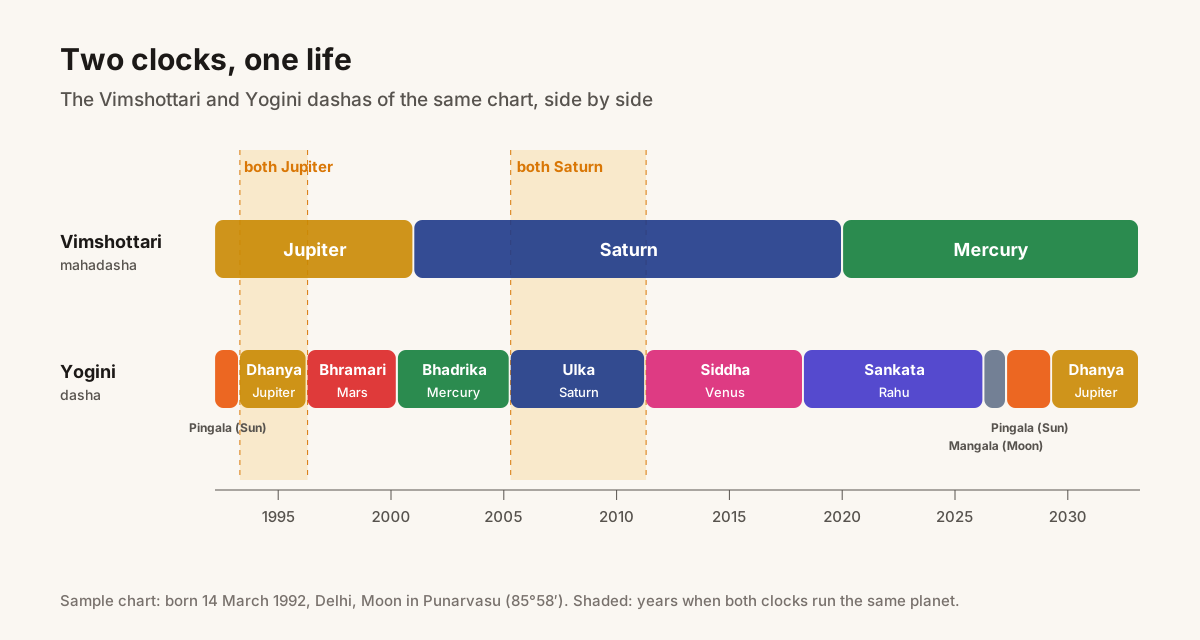
Twice in its first 35 years, both clocks run the same planet:
- April 1993 to April 1996: the Vimshottari dasha is Jupiter's, and the Yogini period is Dhanya, also ruled by Jupiter.
- April 2005 to April 2011: the Vimshottari dasha is Saturn's, and the Yogini period is Ulka, also ruled by Saturn.
During those years, whatever Jupiter or Saturn means in this chart is being signalled by two independent clocks at once. An astrologer would expect that planet's themes to show strongly and clearly then. In the Saturn years, that means its houses, its lessons and its tests, for good or ill depending on where Saturn sits.
Agreement does not have to be the very same planet. Astrologers also look for two lords that work together: both ruling or occupying the houses of the matter in question, or both linked to it by aspect. If you are asking about marriage and both clocks are running planets tied to your 7th house, the case for that period is far stronger than if only one clock points there.
When they disagree
Most of the time the two clocks run unrelated planets. The usual practice is to treat the Vimshottari dasha as the main story and the Yogini period as the colour on top of it.
In the same chart, late 2026 falls in a long Mercury Vimshottari dasha, while the Yogini clock has just moved from eight years of Sankata into a one-year Mangala. Read together: Mercury's long themes of skills, speech and effort continue, while the Yogini change suggests a year that feels lighter than the eight before it.
When the clocks pull in opposite directions, a careful astrologer becomes more careful. A promising Vimshottari period that falls in a testing Yogini one is a period that may deliver, but with more effort or delay. That is a reason to speak of possibilities, not certainties.
Finding your own Yogini periods
You need an accurate birth date, time and place, because the starting yogini depends on the Moon's exact position. A Moon near the edge of a nakshatra can change the whole sequence, so an uncertain birth time is worth checking first with the free birth-time finder.
On Vedhora, sign in and open your dashboard. Download full kundli now lists every Yogini period from your birth onwards, with the sub-periods of the one you are in, next to your Vimshottari dashas, so you can see where your own two clocks agree.
The takeaway
The Yogini dasha is a fast, 36-year second clock that runs alongside Vimshottari from the same Moon. Each of its eight periods has a traditional character, from easy Mangala to unsettled Sankata, but the results come through its lord as placed in your chart. Its greatest value is confirmation: the years when both clocks run the same planet, or planets tied to the same matter, are the years to watch most closely.
To understand the main clock in depth, read how a dasha unfolds. To ask what your own current periods mean, ask your personal astrologer.
Discover Your True Planetary Placements
Calculate your true Sidereal Lagna, Chandra Rashi, Nakshatras, and 120-year Vimshottari Dasha timeline with verified astronomical precision.
Calculate Your Free Kundli