
Planetary Friends and Enemies
Why is Saturn uneasy in the Sun's sign? Parashara's rules for natural and temporary friendship between planets, and the five-fold compound relationship.
Planets in Vedic astrology have relationships. Some get along, some don't, and some are indifferent. Those relationships decide how comfortable a planet feels in another's sign, how two planets behave together, and even how a couple's Moon signs match (guna milan).
Parashara builds it in three layers. Here they are.
Layer 1: natural friendship (naisargika)
Natural friendship is permanent: it's the same in every chart. The Brihat Parashara Hora Shastra (BPHS 3.55) gives a rule to derive it rather than just a table to memorise:
"Note the Rasis, which are the 2nd, 4th, 5th, 8th, 9th and 12th from the Mooltrikon of a Grah. The Grahas ruling such Rasis are its friends, apart from the Lord of its exaltation Rasi. Lords other than these are its enemies. If a Grah becomes its friend as well as its enemy ... then it is neutral."
Worked through for the Sun: its moolatrikona is Leo. Count from Leo:
- 2nd, Virgo: Mercury
- 4th, Scorpio: Mars
- 5th, Sagittarius: Jupiter
- 8th, Pisces: Jupiter
- 9th, Aries: Mars
- 12th, Cancer: the Moon
- The Sun's exaltation sign is Aries: Mars
So the Moon, Mars and Jupiter are friends. Mercury rules Virgo (a friend-house) but also Gemini (not in the list), so it's neutral. Venus and Saturn rule none of these signs, so they're enemies.
Run the rule for every planet and you get the classical table:
- Sun: friends Moon, Mars, Jupiter. Neutral Mercury. Enemies Venus, Saturn.
- Moon: friends Sun, Mercury. Neutral to all others. No enemies.
- Mars: friends Sun, Moon, Jupiter. Neutral Venus, Saturn. Enemy Mercury.
- Mercury: friends Sun, Venus. Neutral Mars, Jupiter, Saturn. Enemy Moon.
- Jupiter: friends Sun, Moon, Mars. Neutral Saturn. Enemies Mercury, Venus.
- Venus: friends Mercury, Saturn. Neutral Mars, Jupiter. Enemies Sun, Moon.
- Saturn: friends Mercury, Venus. Neutral Jupiter. Enemies Sun, Moon, Mars.
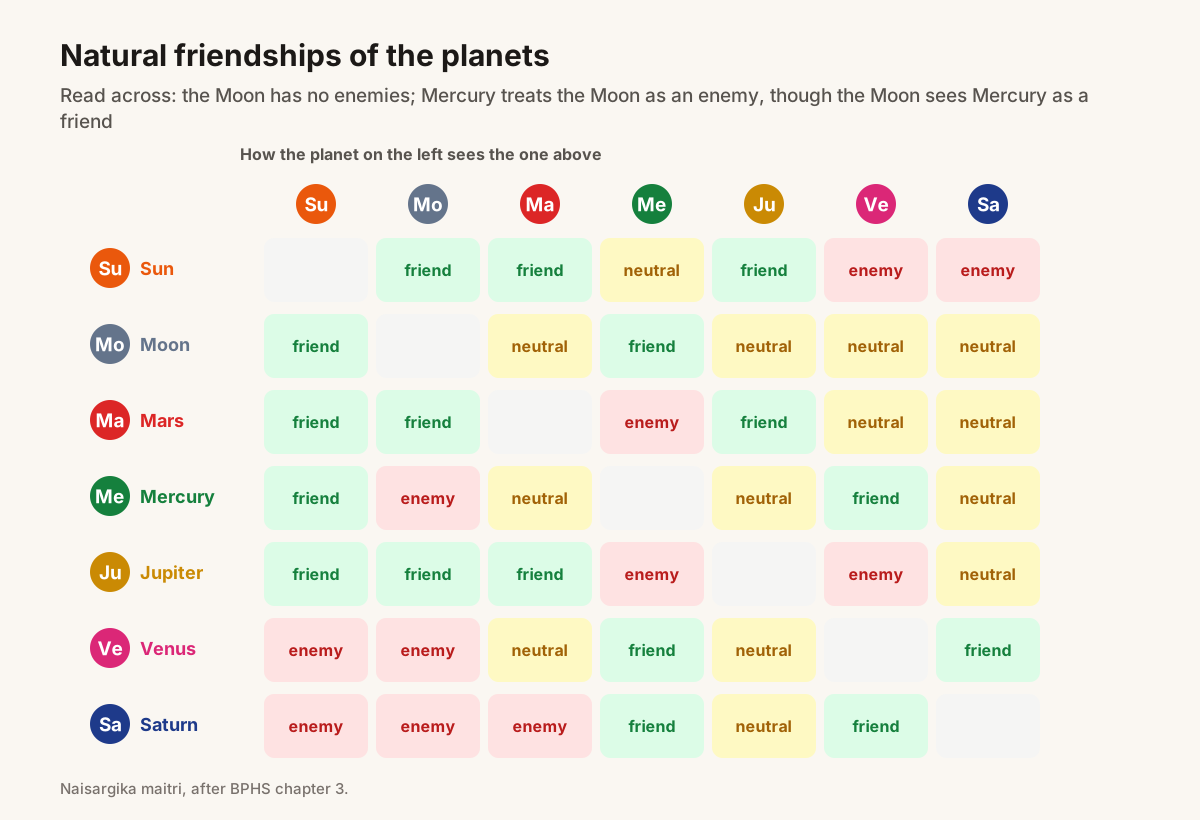
Two things stand out. The planets fall into two camps: the Sun, Moon, Mars and Jupiter on one side, and Mercury, Venus and Saturn on the other. That's the old story of the gods' court and the asuras' court (the planetary cabinet). And friendship isn't always mutual. The Moon counts Mercury as a friend, but Mercury counts the Moon as an enemy (Mercury, the prince).
Layer 2: temporary friendship (tatkalika)
The second layer depends on your chart. BPHS 3.56:
"The Grah, posited in the 2nd, 3rd, 4th, 10th, 11th, or the 12th from another, becomes a mutual friend. There is enmity otherwise."
So two planets close together, in neighbouring signs within three signs either way, are temporary friends. Planets in the same sign, or in the 5th to 9th from each other, are temporary enemies.
Example (our sample chart, 14 March 1992, Delhi):
- Moon (Gemini) and Jupiter (Leo): Jupiter is 3rd from the Moon, so they're temporary friends.
- Mars and Saturn, both in Capricorn: same sign, so temporary enemies.
- Venus (Aquarius) and Saturn (Capricorn): Saturn is 12th from Venus, so temporary friends.
Layer 3: the compound relationship (panchadha)
Finally you combine the two. BPHS 3.57–58 gives the five-fold result:
- Natural friend + temporary friend = great friend (adhi-mitra)
- Natural neutral + temporary friend = friend
- Natural friend + temporary enemy = neutral
- Natural neutral + temporary enemy = enemy
- Natural enemy + temporary enemy = great enemy (adhi-shatru)
- And natural enemy + temporary friend = neutral
Example: Saturn and Venus are natural friends, and in our sample chart they're also temporary friends, so they're great friends here. Mars regards Saturn as neutral by nature, but the two share a sign here, which makes them temporary enemies. So from Mars's side, Saturn becomes an enemy.
Why it matters
1. A planet's comfort in a sign. A planet in a friend's sign is at ease, and in an enemy's sign it's strained. BPHS even quantifies a planet's capacity to do good: full in exaltation, three-quarters in moolatrikona, half in its own sign, a quarter in a friend's sign, an eighth in a neutral's, and none in debilitation or an enemy's sign (planetary dignity).
2. Conjunctions. Two friends together cooperate. Two enemies together compete. Saturn with the Sun, for example, is a classic tension of father and son, authority and duty.
3. Dashas. BPHS notes that antardashas of a dasha lord's natural and temporary friends give good results, and those of enemies give adverse ones.
4. Marriage matching. Graha maitri, one of the eight kootas, scores the friendship between the lords of the two Moon signs, and is worth 5 of the 36 points.
The takeaway
Planetary friendship comes in three layers. Natural friendship is fixed in every chart, derived from each planet's moolatrikona and exaltation. Temporary friendship is set by your chart: neighbours within three signs are friends. The compound five-fold scale combines them, from great friend to great enemy. Together they tell you how comfortable each planet is, how conjunctions behave and how periods will feel.
Calculate your chart free and check which of your planets sit in friendly signs. For how planets see one another, read drishti: planetary aspects.
Discover Your True Planetary Placements
Calculate your true Sidereal Lagna, Chandra Rashi, Nakshatras, and 120-year Vimshottari Dasha timeline with verified astronomical precision.
Calculate Your Free Kundli