
The 12 Houses, Simply Explained
What each of the twelve houses of a Vedic chart governs, in Parashara's words and plain language, plus the house groups astrologers use and a strength test.
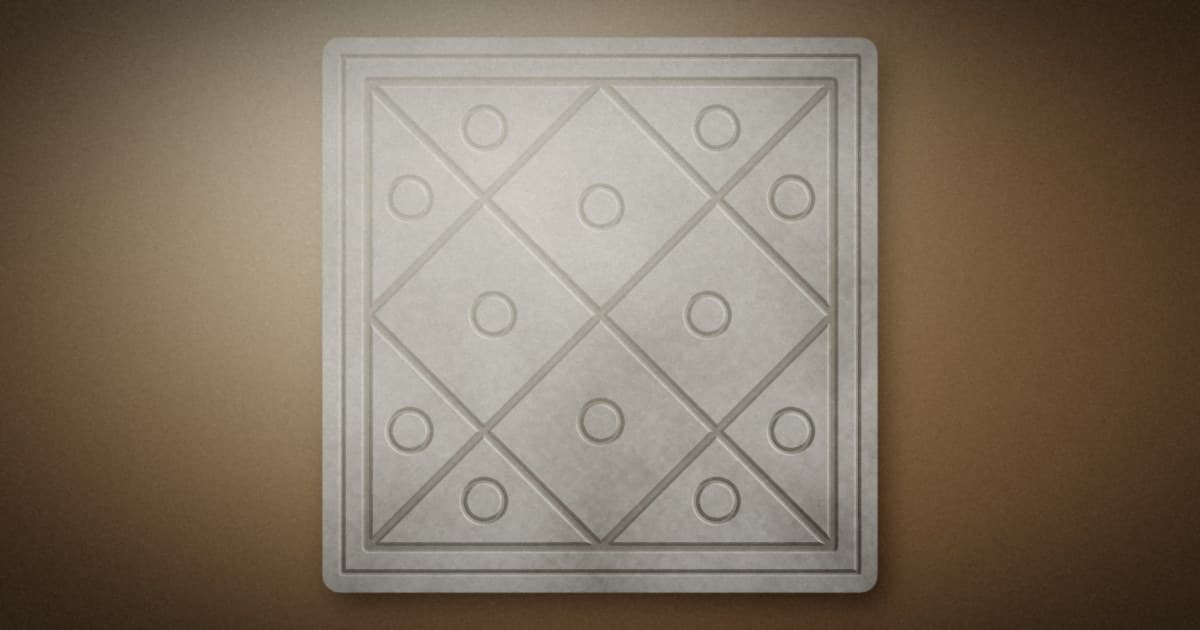
If the planets are the actors in your chart, the houses are the stages. There are twelve, called bhavas, and each one is a department of life: body, wealth, siblings, home, children, health, marriage, longevity, fortune, career, gains and losses.
Here's what each house governs, first in the words of the Brihat Parashara Hora Shastra (BPHS, Chapter 11), then in plain modern language.
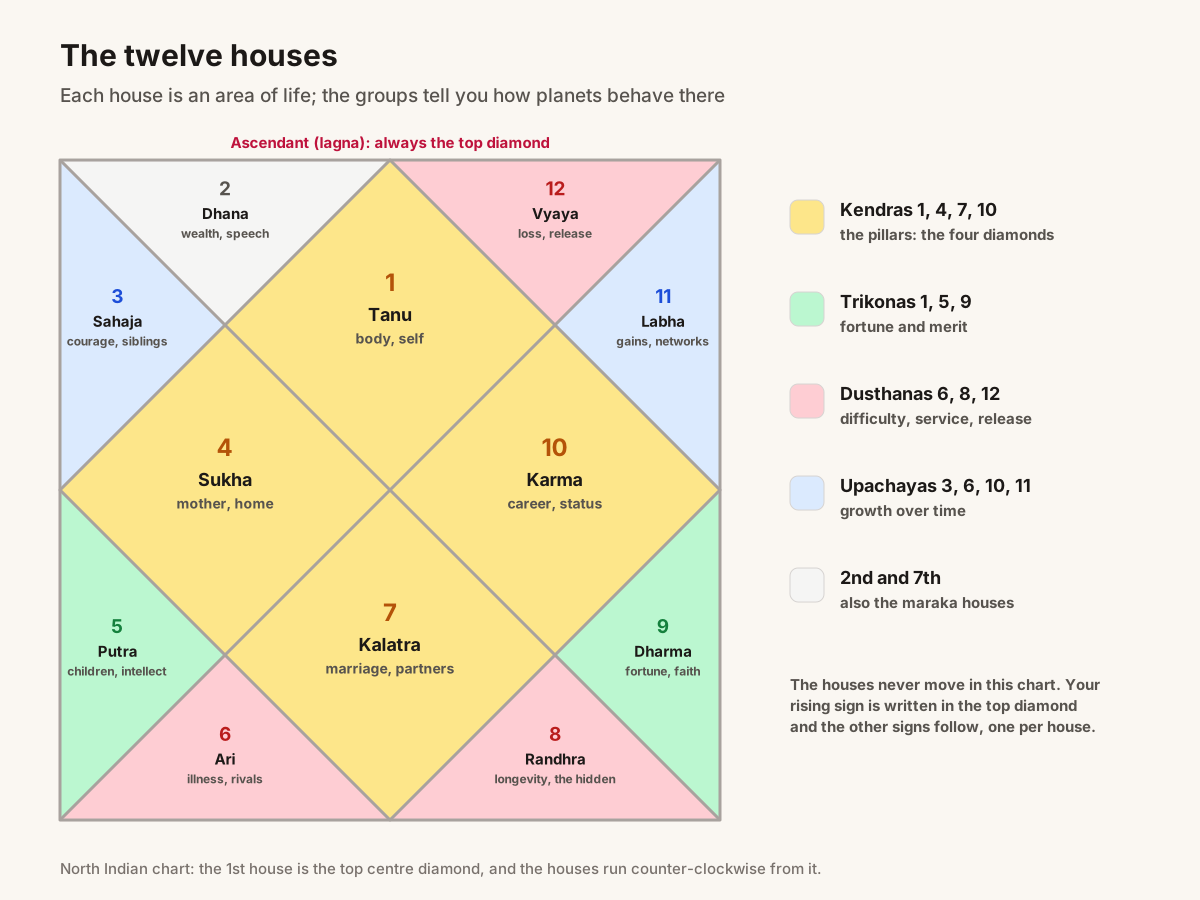
The twelve houses
1st house: Tanu, the body. BPHS: "Physique, appearance, intellect ... complexion of the body, vigour, weakness, happiness, grief and innate nature." In plain terms: you. Your body, health, temperament and the lens through which the whole chart is read (the ascendant explained).
2nd house: Dhana, wealth. BPHS: "Wealth, grains (food etc.), family, death, enemies, metals, precious stones." In plain terms: money you keep, family, food, speech, the face and early childhood.
3rd house: Sahaja, courage. BPHS: "valour, servants ... brothers, sisters ... initiatory instructions, journey." In plain terms: effort, courage, younger siblings, skills, communication, short journeys and initiative.
4th house: Bandhu or Sukha, home and heart. BPHS: "Conveyances, relatives, mother, happiness, treasure, lands and buildings." In plain terms: mother, home, property, vehicles, emotional peace and basic education.
5th house: Putra, children and intelligence. BPHS: "amulets, sacred spells, learning, knowledge, sons, royalty (or authority)." In plain terms: children, creativity, intelligence, mantras and devotion, past-life merit and romance.
6th house: Ari, enemies and obstacles. BPHS: "Maternal uncle ... enemies, ulcers, step-mother." In plain terms: illness, debt, enemies and competition, but also daily work, service and the strength to overcome.
7th house: Yuvati or Kalatra, partnership. BPHS: "Wife, travel, trade." In plain terms: marriage, partners, business deals, the public and travel (how astrology times marriage).
8th house: Randhra, the hidden. BPHS: "longevity, battle, enemies, forts, wealth of the dead, and things that have happened and are to happen." In plain terms: longevity, crises and transformation, inheritance, research, the occult and the unknown.
9th house: Dharma, fortune. BPHS: "Fortunes ... religion ... visits to shrines." In plain terms: luck, faith, teachers, father (in many traditions), higher learning and pilgrimage.
10th house: Karma, action. BPHS: "Royalty (authority), place, profession (livelihood), honour, father, living in foreign lands." In plain terms: career, status, public reputation and the work you're known for (your career chart).
11th house: Labha, gains. BPHS: "All articles ... income, prosperity." In plain terms: income, profits, wishes fulfilled, elder siblings, friends and networks.
12th house: Vyaya, loss and release. BPHS: "expenses, history of enemies, one's own death." In plain terms: expenses, losses, sleep, foreign lands, retreat, spiritual release and the end of things.
The house groups
Astrologers rarely think of houses one at a time. They group them:
- Kendras (1, 4, 7, 10): the four pillars, the most powerful houses for visible life. Planets here act strongly.
- Trikonas (1, 5, 9): the houses of dharma, merit and grace. Their lords are the most auspicious planets in any chart (why).
- Dusthanas (6, 8, 12): the houses of difficulty, which also bring service, depth and letting go (the four trines).
- Upachayas (3, 6, 10, 11): the houses of growth. Malefics actually do well here, and results improve with age and effort.
- Marakas (2, 7): the houses linked to the end of life in longevity analysis, read only by experienced astrologers.
How to judge whether a house is strong
Parashara gives a simple test (BPHS 11.14–16). A house prospers when:
- it holds, or is aspected by, a benefic (Jupiter, Venus, a well-placed Mercury, a strong Moon)
- its lord is strong: in a good state, or placed in the 10th house
A house suffers when:
- its lord doesn't aspect it
- its lord sits with a malefic, or with the lords of the "evil" houses (3, 6, 8, 11, 12)
- its lord is defeated in a planetary war, or weak by state (what planetary war is)
So for any house, look at three things: the planets in it, the aspects on it, and the condition of its lord.
The house from the house
One more principle unlocks a great deal. Each house can be read from another house as if it were the 1st. The 4th is mother, so the 4th from the 4th (your 7th) shows the mother's home and property. The 5th is children, so the 9th from the 5th (your 1st) can show the children's fortune.
This is called bhavat bhavam, "house from house". It's how astrologers read the lives of family members from one chart. For example, the 3rd house from the 7th (your 9th) shows your spouse's siblings. And the 9th house is "wife's brother" in BPHS for exactly this reason.
A worked example
In our sample chart (14 March 1992, Delhi, Pisces ascendant):
- The 11th house of gains holds exalted Mars and own-sign Saturn. That's a strong house of income and networks, built through effort.
- The 6th house holds the ascendant lord Jupiter. The person grows through service, competition and solving problems.
- The 10th house of career holds Rahu, with ambitious, unconventional drive, and its lord Jupiter sits in the 6th, so work is tied to service.
The takeaway
The twelve houses divide life into departments, from the body (1st) to release (12th). Parashara's lists remain the foundation. Read each house through the planets in it, the aspects on it and the strength of its lord. Group the houses to see the shape of a life: kendras for visible power, trikonas for grace, dusthanas for struggle that teaches, upachayas for growth.
Calculate your chart free to see which houses your planets occupy. Next, learn the twelve signs that colour each house.
Discover Your True Planetary Placements
Calculate your true Sidereal Lagna, Chandra Rashi, Nakshatras, and 120-year Vimshottari Dasha timeline with verified astronomical precision.
Calculate Your Free Kundli