
Shadbala: A Planet's Six Strengths
Shadbala measures each planet's strength from six angles. What each strength means, Parashara's minimums, and why a debilitated planet can still score well.

Is your Jupiter strong? It's one of the most common questions in astrology, and also one of the hardest. A planet can be exalted but combust, well placed but retrograde, or in a good house but aspected by Saturn. To settle the question, Parashara designed a system that weighs a planet from six different angles at once: shadbala, "six-fold strength".
The six strengths
The Jyotisha Siddhanta Sara lists them: "1. Sthana bala or positional strength 2. Dik bala or directional strength 3. Kaalabala 4. Cheshta bala or motional strength 5. Naisargika bala or natural strength and 6. Drigbala or aspectual strength." It adds that only the seven planets are measured. The nodes are left out.
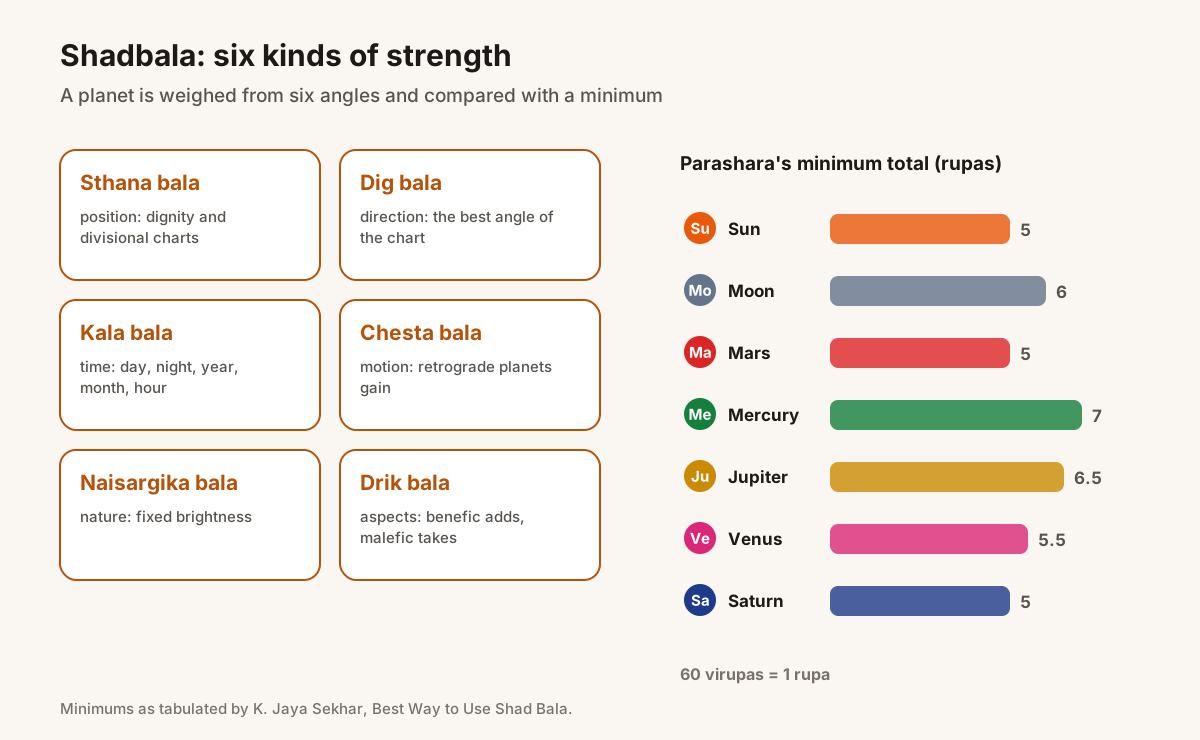
1. Sthana bala: positional strength. The planet's dignity. This covers exaltation, own sign, friends' signs and the divisional charts, plus odd and even signs, kendra placement and the decanate. It's the biggest single component. K. Jaya Sekhar notes in Best Way to Use Shad Bala that it's "about 4 times the basic Naisargika Bala" (planetary dignity).
2. Dig bala: directional strength. Each planet is strongest in one direction, meaning one angle of the chart. That's Jupiter and Mercury in the 1st (east), the Sun and Mars in the 10th (south), Saturn in the 7th (west), and the Moon and Venus in the 4th (north) (dig bala explained).
3. Kala bala: temporal strength. Strength from when you were born. Day or night (the Moon, Mars and Saturn are strong at night), the bright or dark fortnight, the Sun's northern or southern course, and the lords of your birth year, month, day and hour. Those lords get 15, 30, 45 and 60 virupas respectively (the planetary cabinet).
4. Chesta bala: motional strength. Strength from motion. A retrograde planet gets high chesta bala, because it's near its closest approach to Earth (retrograde planets). For the Sun, chesta bala is its northern-course strength, and for the Moon it's its waxing strength.
5. Naisargika bala: natural strength. A fixed value, the same in every chart, which the Jyotisha Siddhanta Sara says is "in direct proportion to the luminosity or brightness of the planet." The Sun gets 1 rupa, the Moon 0.857, Venus 0.714, Jupiter 0.571, Mercury 0.429, Mars 0.286 and Saturn 0.143. It works as a tie-breaker. When two planets score the same, "the brighter of the two planets prevails."
6. Drik bala: aspectual strength. Benefic aspects add strength and malefic aspects subtract it (how aspects work).
Units and minimums
Shadbala is counted in virupas, and 60 virupas make one rupa. Parashara sets a minimum total each planet needs to deliver its results well. As Jaya Sekhar tabulates it:
- Sun: 300 virupas (5 rupas)
- Moon: 360 (6)
- Mars: 300 (5)
- Mercury: 420 (7)
- Jupiter: 390 (6.5)
- Venus: 330 (5.5)
- Saturn: 300 (5)
A planet above its minimum can deliver what it promises. A planet below it struggles, however good its placement looks.
Jaya Sekhar also makes an interesting observation. Even at the bare minimum in each of the first five strengths, the Sun, Moon, Jupiter and Venus can absorb some negative aspects and still pass. Mars, Mercury and Saturn need help from good aspects to reach their minimums.
A worked example
Vedhora's engine uses a simplified version of shadbala, scoring each component out of 100. Here's how the sample chart (14 March 1992, Delhi) comes out:
- Mars: 76 overall, the strongest. Full positional strength (exalted in Capricorn), full motional strength, and strong direction and time.
- Moon: 57. Full directional strength (it sits in the 4th, the north) and strong temporal strength.
- Saturn: 53. Strong position (own sign) and time.
- Sun: 43.
- Mercury: 42. Zero positional strength (it's debilitated), yet full directional strength, because it sits in the 1st house, its best direction.
- Venus: 37.
- Jupiter: 30, the weakest by this measure. It's in the 6th house and gets little directional strength there.
Mercury's case shows why shadbala exists. Judged by sign alone, Mercury looks hopeless. Judged by direction, it's at its peak. The six strengths keep one factor from deciding everything.
How to use shadbala
- Rank your planets. The strongest planet is often the one that defines your life's main theme. In our example, that's exalted Mars in the 11th house of gains.
- Check the dasha lord. A strong dasha lord delivers its promises. A weak one delivers them partially or with effort.
- Look inside the total. A planet strong in direction but weak in position (like this Mercury) works well in its own sphere but lacks confidence.
- Don't use shadbala alone. It measures capacity, not whether the planet is a benefic or malefic for your ascendant. A strong functional malefic is strong at causing trouble (functional nature).
The takeaway
Shadbala weighs a planet from six angles: position, direction, time, motion, nature and aspects. It reports the total against Parashara's minimum for each planet. It's how astrologers move from "this planet looks good" to "this planet can deliver". And it often shows that a planet's weakness on one front is balanced by strength on another.
Calculate your chart free to see your planets' strength scores on Vedhora.
Discover Your True Planetary Placements
Calculate your true Sidereal Lagna, Chandra Rashi, Nakshatras, and 120-year Vimshottari Dasha timeline with verified astronomical precision.
Calculate Your Free Kundli