
Sun and Moon: Soul and Mind in Vedic Astrology
Why is the Sun, the soul, called a malefic and tied to ego? How Vedic astrology sees the Sun and Moon, and why they succeed as companions.
Two lights rule a Vedic chart before any other planet is read: the Sun and the Moon. The classical texts call them the king and queen of the planetary cabinet. And they open with a striking statement: the Sun is the soul, and the Moon is the mind.
That raises an obvious puzzle. If the Sun is the soul — the truest part of us — why do the same texts list it among the malefics? And why do modern readings so often tie the Sun to ego and pride? The answer turns out to say a great deal about how the soul and mind are meant to live together.
The classical starting point
Parashara's Brihat Parashara Hora Shastra, the foundational text of Vedic astrology, describes the planets as the faculties of the cosmic person (Kalapurusha): the Sun is the soul (atma), the Moon the mind (manas), Mars strength, Mercury speech, Jupiter knowledge and happiness, Venus desire, Saturn sorrow. Every serious teacher of the Parashari tradition builds on this — including modern authors such as P.V.R. Narasimha Rao, whose Vedic Astrology: An Integrated Approach has introduced a generation of students to the system.
The Sun and Moon are also unique in a practical way: each rules only one sign — the Sun Leo, the Moon Cancer — while every other classical planet rules two. They are the two poles of the chart, the solar and the lunar, around which the rest arranges itself.
Why is the soul a "malefic"?
In Jyotish, malefic (krura, literally "cruel" or "harsh") does not mean evil. It means a planet whose nature is hot, drying, separating — one that cuts, burns away and creates distance. Saturn, Mars, Rahu and Ketu are malefics; so is the Sun.
Think about what the Sun does physically. It gives life, and it burns. It lights everything, and nothing can stand too close to it. A planet that comes within a few degrees of the Sun is said to be combust (asta) — overwhelmed, its own light lost in the glare.
That is exactly the double nature of the self:
- At its best, the Sun is purpose, dignity, integrity, the inner king — the one who acts from what is true rather than from what is convenient. A strong, well-placed Sun gives confidence, leadership, health and a clear sense of direction.
- Unbalanced, the same fire becomes pride, rigidity and the need to be seen — the ego that burns what comes near it. People with an afflicted Sun often struggle with authority, either craving it or fighting it, and can find it hard to let others shine.
The tradition's point is subtle. The soul itself is not the ego. But the soul's fire, when it is mistaken for "me and mine", becomes ego. The Sun is classed as harsh because its light is uncompromising — it shows what is real and burns what is false. That is not comfortable, and it is not meant to be.
The Moon: the mind that reflects
The Moon has no light of its own. Everything it shines with is the Sun's light, reflected. Jyotish takes this astronomical fact as a spiritual one: the mind is bright to the extent that it reflects the soul.
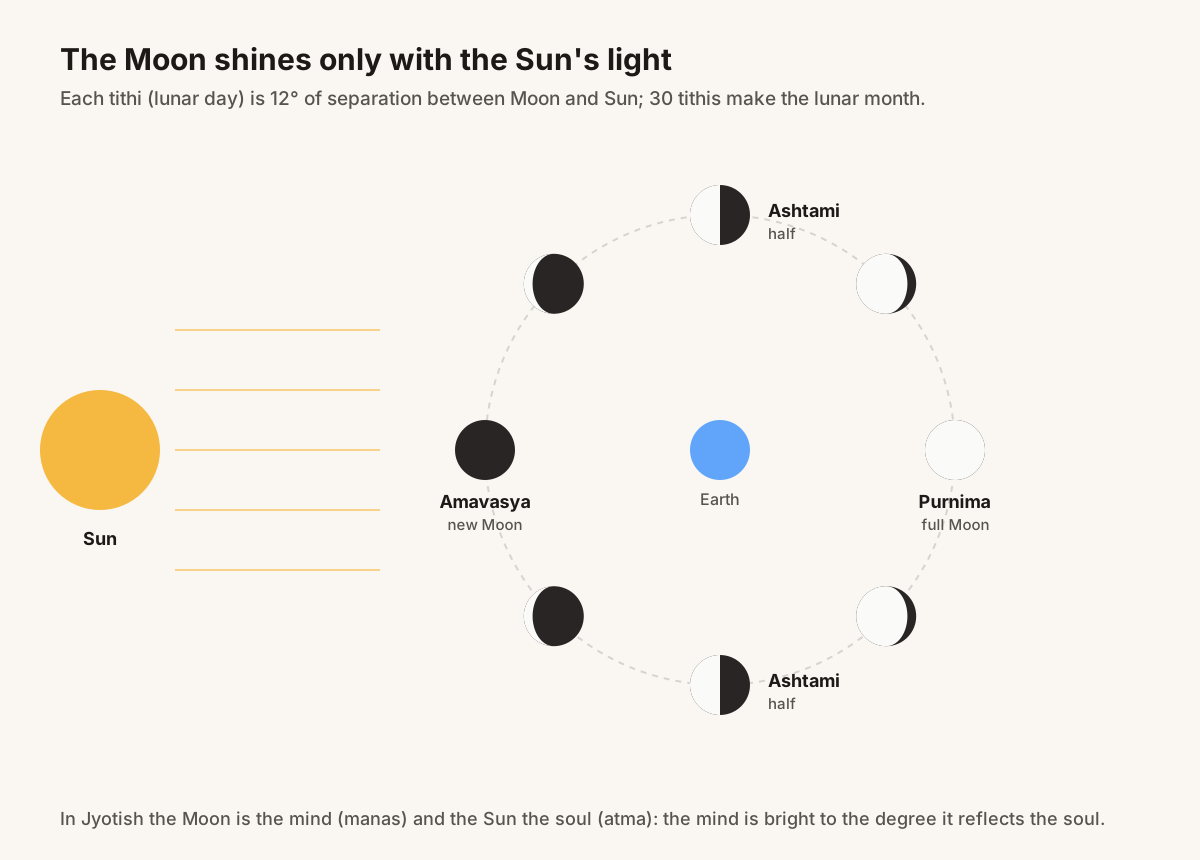
The Moon's whole cycle is a relationship with the Sun:
- At Amavasya (new Moon), the Moon sits with the Sun and shows no light to us. The mind is turned entirely inward — a time traditionally kept for rest, ancestors and quiet.
- As the Moon moves away, it waxes. Every 12° of separation is one tithi, a lunar day; thirty tithis make the lunar month.
- At Purnima (full Moon), the Moon stands opposite the Sun and reflects all of its light — the mind at its fullest, most expressive, most emotional.
This is why Jyotish treats a waxing, bright Moon as a benefic and a weak, dark Moon as more difficult, and why the Moon's strength by phase (paksha bala) matters so much. It is also why the Moon is the basis of so much in Vedic astrology: your Moon sign, your birth nakshatra, and your entire dasha sequence are all read from it.
The Moon signifies the mother, nurturing, emotional security, memory, the public, and the daily rhythm of feeling. A strong Moon gives emotional resilience and a sense of being at home in the world; a troubled Moon gives restlessness, worry, and moods that follow every change in the weather.
Why they need each other
Here is the heart of it — and this is our reading of the classical picture rather than a quotation from any one teacher.
A Sun without the Moon is purpose without feeling: clarity, ambition and authority, but little warmth, empathy or adaptability. Such a person may achieve a great deal and still feel alone, or leave others feeling unseen.
A Moon without the Sun is feeling without direction: sensitivity, imagination and care, but easily swayed, dependent on circumstances and on other people's approval.
When the two work together, something else becomes possible. The soul gives the mind a direction; the mind gives the soul a way to move through the world — to listen, adapt, relate and be understood. Purpose becomes humane, and feeling becomes steady. In the language of the chart, the king and queen rule together.
You can see this in how astrologers read the pair:
- The houses of Sun and Moon from each other. When the Moon sits in a good position from the Sun (and vice versa), inner purpose and emotional life tend to cooperate; when they are in difficult positions, people often feel pulled between what they should do and what they feel.
- Conjunction and opposition. Born near the new Moon, a person may be deeply self-directed but find emotional expression harder; born near the full Moon, they may be expressive and visible, with the work being inner steadiness.
- Their strength and dignity. The Sun is exalted in Aries and debilitated in Libra; the Moon is exalted in Taurus and debilitated in Scorpio. Their condition, and the houses they rule, show where the soul's confidence and the mind's peace come easily — and where they must be cultivated.
Bringing the two lights into harmony
The traditional practices for the luminaries are simple and very old:
- For the Sun: rise early and greet the sunrise (Surya namaskara or simply offering water to the rising Sun), keep your word, respect your father and teachers, and act from principle rather than from the wish to be seen. These steady the fire without feeding the ego.
- For the Moon: protect your sleep and your emotional rhythms, honour your mother and the people who nourish you, spend time near water, and make room for quiet on Amavasya and joy on Purnima. These steady the mind.
The deeper practice is the one the Moon's own light teaches: become a clearer mirror. The more the mind settles, the more of the soul's light it can carry — and the more a person can succeed without losing either their warmth or their way.
To see where your Sun and Moon sit, how they relate, and which of them your current period emphasises, calculate your chart free — or ask the astrologer how your soul and mind are working together right now.
Discover Your True Planetary Placements
Calculate your true Sidereal Lagna, Chandra Rashi, Nakshatras, and 120-year Vimshottari Dasha timeline with verified astronomical precision.
Calculate Your Free Kundli