
Astrology and Science: The Untold Side
In 1975, 186 scientists signed a statement against astrology. What came next: Carl Sagan's refusal to sign, Gauquelin's research and Jung's letter to Raman.
You have probably heard the line: scientists have proven astrology is nonsense. It sounds settled. But when you look at where that claim comes from, the story is far more interesting, and much less one-sided, than the headline.
Most of what follows comes from a book many people have never heard of: Astrology and the Hoax of "Scientific Temper", edited by Gayatri Devi Vasudev, daughter of the famous Indian astrologer Dr. B.V. Raman. It collects the papers, letters and rebuttals that usually get left out of the conversation.
The famous statement of 1975
In 1975 the American magazine The Humanist published "Objections to Astrology", a short statement signed by 186 scientists, some of them Nobel laureates. It was drafted around a note by the astronomer Bart Bok and mailed to thousands of newspaper editors. To this day it is quoted as proof that science has spoken.
What is rarely mentioned:
- A counter-statement followed. 187 people with academic degrees signed a reply contradicting it.
- Not every big name agreed to sign. The astronomer Carl Sagan, no astrologer himself, declined. He wrote that he could not endorse it because its tone was authoritarian, and he pointed out that chemistry, medicine and astronomy also began in old beliefs. Where something came from, he said, isn't the point.
- Many signers hadn't studied the subject. The philosopher of science Paul Feyerabend noted that, after the statement appeared, many of the signatories declined interviews because they had never studied astrology. They had attacked its basic assumptions, he said, not the way it is actually practised.
The argument that didn't hold up
Bok's case rested on two simple claims: the planets are too far away to affect us, and the walls of a delivery room would shield a newborn from anything they emit.
Feyerabend's reply, quoted in the book, is worth reading slowly. An astronomer should know that the planets can affect solar activity, which in turn has many effects on Earth. And some kinds of radiation pass through very thick walls, delivery rooms included. The objections were confident, but they weren't careful.
The psychologists H.J. Eysenck and D.K.B. Nias put the real problem plainly in Astrology: Science or Superstition?: it is possible there is no truth in astrology, but the 186 scientists had not shown it. To do that, you would have to examine the evidence in its favour and show where it fails. Signing a statement is not the same as running an experiment.
What one researcher actually found
The French researcher Michel Gauquelin spent decades collecting the birth times of famous professionals, then checked where the planets stood in the sky when they were born.
His own words, reprinted in the book:
"In my research, I had observed Mars dominating the births of men of war and sports champions, Jupiter being dominant with actors, Saturn with scientists and the Moon with poets."
The planets showed up in particular sectors of the sky, just after rising or just after reaching the highest point. Astrologers had described Mars as martial, Jupiter as jovial, Saturn as studious and the Moon as poetic for thousands of years. Gauquelin wasn't trying to defend astrology. He went looking and found its old symbolism in the birth data.
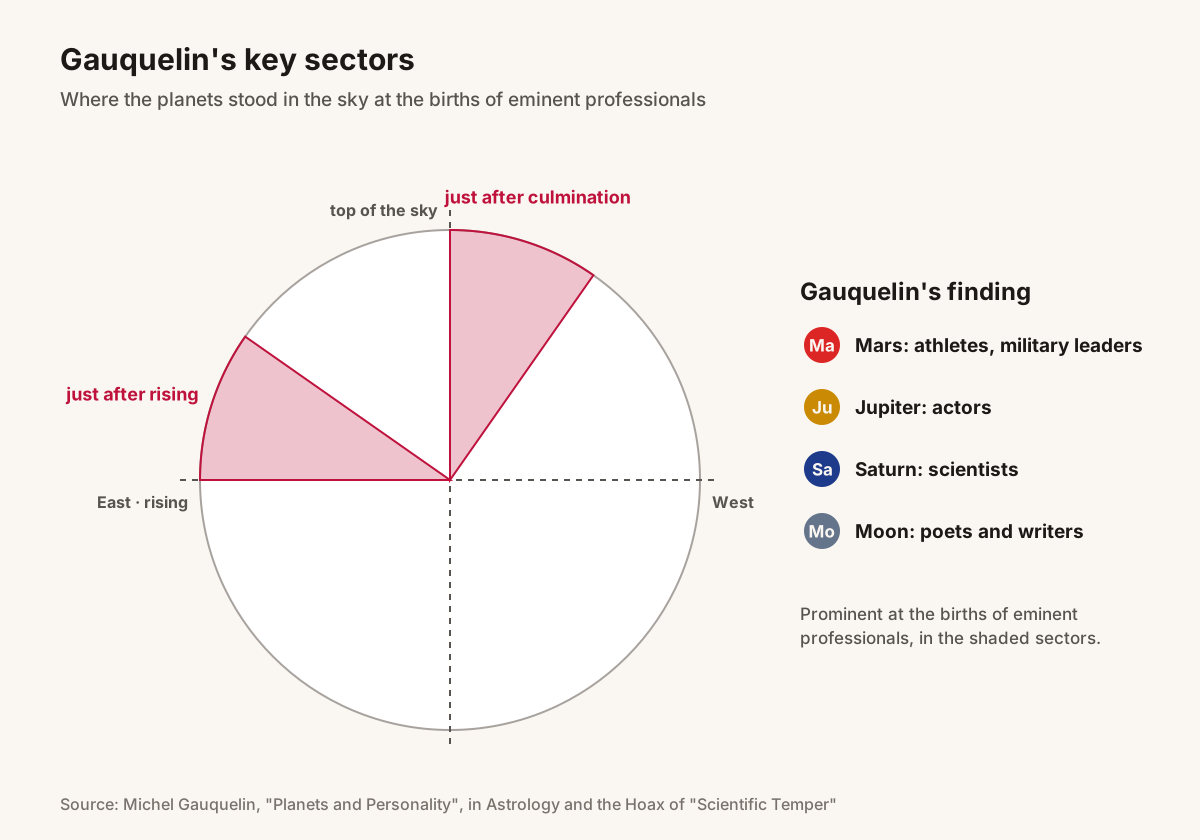
For Jyotish this will sound familiar. A planet near the ascendant or the 10th house is in a kendra, an angle, and the classical texts have always treated angular planets as the ones that shape a life most visibly.
A psychologist's letter to an astrologer
In September 1947 the Swiss psychiatrist Carl Jung wrote to Dr. B.V. Raman in Bangalore. The letter is reproduced in the book:
"In cases of difficult psychological diagnosis I usually get a horoscope in order to have a further point of view from an entirely different angle. I must say that I very often found that the astrological data elucidated certain points which I otherwise would have been unable to understand."
This is one of the founders of modern psychology saying the chart helped him see what his own methods missed. That is very close to how a good Vedic astrologer works today: the chart as a second, independent view of a person.
Jyotish was never a matter of guesswork
In India, astrology was never a fringe pastime. Jyotish is one of the six Vedangas, the limbs of the Veda. It is traditionally called the eye of the Veda because it tells you when. Its foundations are astronomy:
- It uses the real stars. Vedic astrology uses the sidereal zodiac, which stays tied to the fixed stars, and corrects for the slow precession of the equinoxes. That's why your Vedic sign can differ from your Western one (see how ayanamsa works).
- Its astronomy was precise. Aryabhata gave the distances from the Sun at which each planet disappears in its glare, and the combustion limits astrologers use today are almost the same figures (more on combust planets).
- Its predictions are tied to time. Systems like the Vimshottari dasha are worked out from the Moon's exact position at birth, not from vague sun-sign generalities (how the dasha clock is set).
The book's opening anecdote makes the cultural point well. When his grandson Rajiv was born, Jawaharlal Nehru wrote asking for "a proper horoscope made by a competent person." This was a modern, scientifically minded statesman, and he still treated the birth record as worth keeping properly.
How to judge astrology fairly
The fair test of any practice is how it performs when done properly, not a slogan for or against it. For Jyotish that means:
- An accurate birth time, because the ascendant changes about every two hours.
- The whole chart: dignity, aspects, divisional charts, the dasha running, the transits. Not one placement read in isolation.
- Specific, timed statements you can check against your own life.
That is how Vedhora works. Your chart is calculated precisely, matched against thousands of rules drawn from the classical texts, and turned into readings with real periods you can hold up to experience. Calculate your chart free and judge for yourself.
The bottom line
The case against astrology is usually told as a closed one. It isn't. A statement signed by people who hadn't studied the subject was answered by scientists and philosophers who had. A researcher who set out to test the planets found their oldest meanings in his data. And Carl Jung used horoscopes when his own tools fell short. Jyotish has outlived many confident critics. The best way to understand it is to look at it closely, in your own chart.
Discover Your True Planetary Placements
Calculate your true Sidereal Lagna, Chandra Rashi, Nakshatras, and 120-year Vimshottari Dasha timeline with verified astronomical precision.
Calculate Your Free Kundli